ChatGPT Shopping Is Starting to Look Very Different
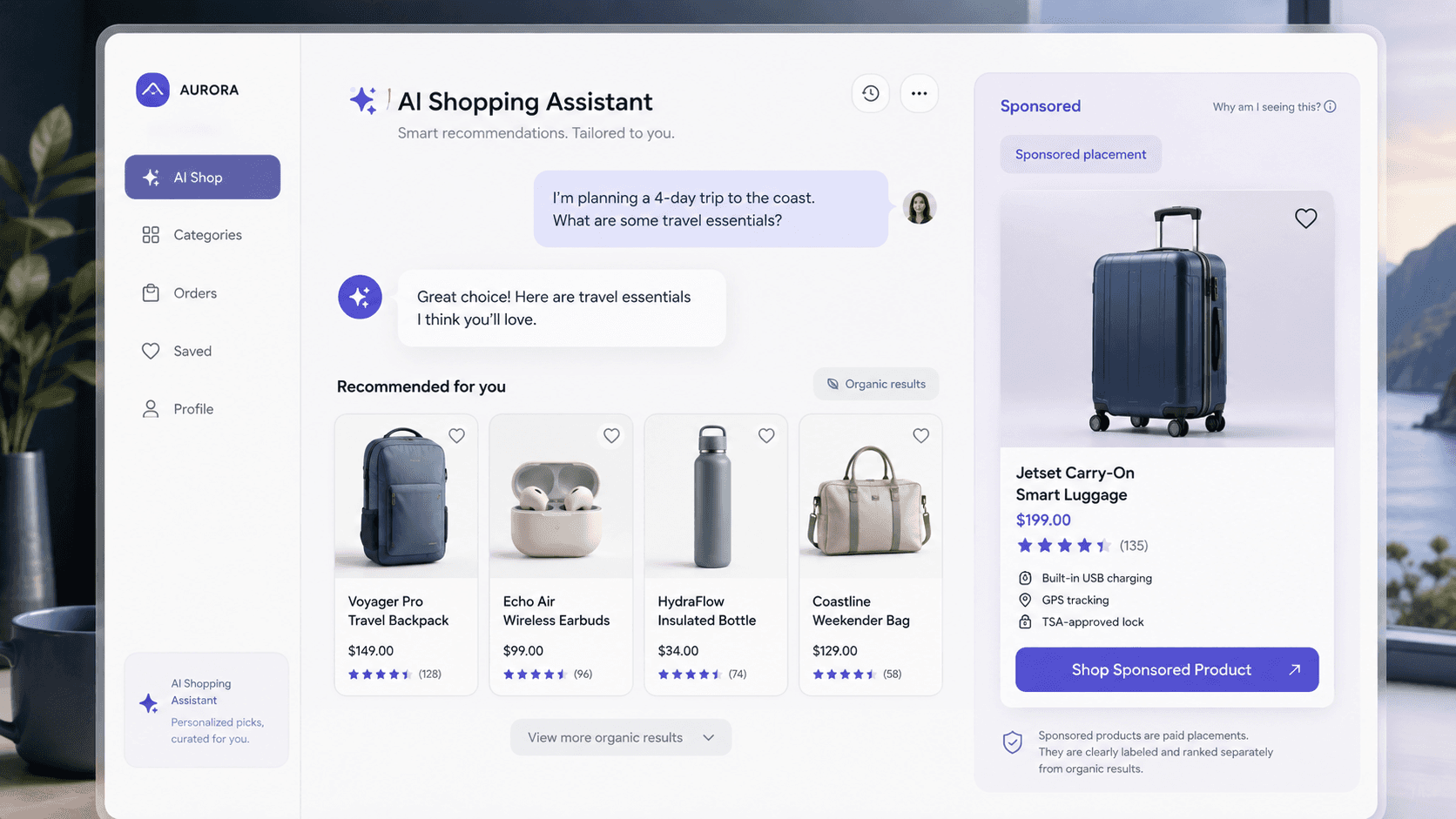
Ecommerce discovery is moving into a new phase because product research and advertising can now exist within the same AI conversation. People can use ChatGPT to compare products, narrow down options, understand tradeoffs, research prices, and decide what fits their needs, while sponsored placements can appear separately within that broader experience.
For brands, this creates a question that sounds much simpler than it really is: can you pay ChatGPT to recommend your product?
The answer depends on what we mean by recommendation.
OpenAI says the products selected for organic shopping results are chosen independently and are not advertisements. Ads sit separately from those product results, which means paying for advertising does not give a merchant the ability to purchase a position inside ChatGPT's organic recommendation itself. (OpenAI)
At the same time, ChatGPT advertising is becoming increasingly relevant to ecommerce. Retail advertisers can use product feeds to make catalog items eligible for ads, and those sponsored products can appear while customers are actively researching and comparing what to buy. (OpenAI)
This creates two routes into the same buying journey. One is earned through product relevance, while the other is purchased through advertising.
Understanding the difference between those two routes is becoming important because, as XENA explores in its guide to the AI retail search shift in 2026, shopping discovery is becoming less dependent on a fixed search results page and more dependent on how well a system can understand the shopper's intent.
Organic Recommendations Still Have to Be Earned
OpenAI's shopping documentation is clear that its product results are selected independently and are not influenced by advertising partnerships. The system can consider the person's request and conversational context, alongside information such as product price, availability, reviews, and other details that help it judge relevance.
For ecommerce brands, this changes what being discoverable can mean.
A product does not simply need to match a phrase. It needs to make sense within the context of what someone is trying to buy.
That puts much more emphasis on product information.
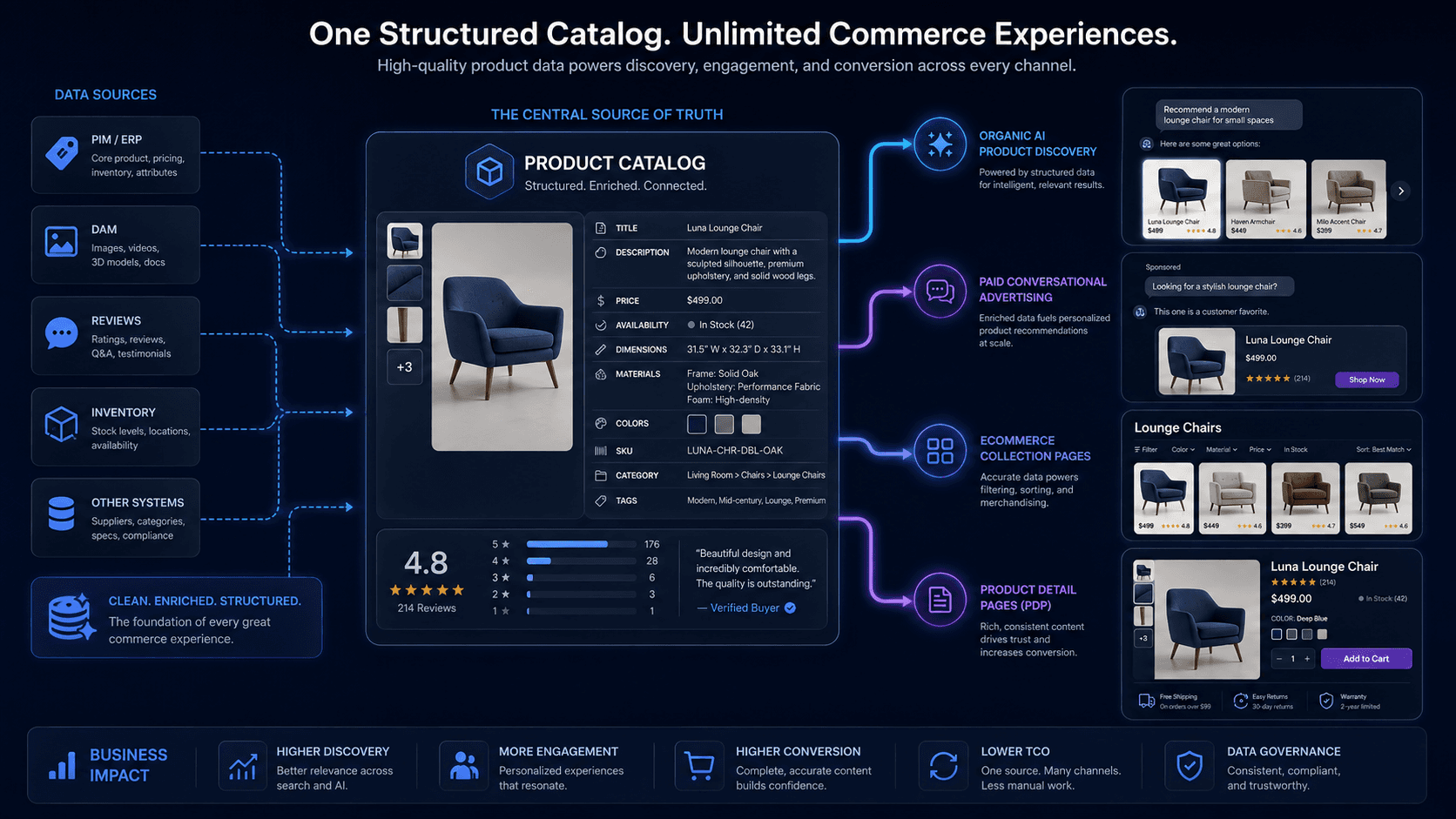
When titles, attributes, descriptions, specifications, images, reviews, pricing, and availability clearly explain an item, an AI system has more information available when deciding whether that product belongs in a particular recommendation.
When those details are vague or inconsistent, the opposite can happen. A product may be a strong fit for the customer while still being difficult for an AI system to understand confidently.
XENA's guide on how to write product pages AI actually understands goes deeper into this issue, particularly the role of clear attributes, product facts, use cases, and supporting information.
The same challenge appears at the catalog level. XENA's ChatGPT product visibility guide explains how product feeds, product pages, reviews, images, and wider brand information can influence whether a catalog is easy for AI shopping systems to interpret.
This is why organic AI visibility should not be treated as a new version of keyword stuffing. The objective is not to repeat more phrases in the hope that a system notices them. The objective is to give the system enough useful information to understand where the product genuinely fits.
Paying for Visibility Is a Separate Route
The advertising side works differently.
OpenAI says ChatGPT ads are separate from the assistant's answer, and its ad system can consider signals such as the context and intent of the conversation, the advertiser's landing page, ad copy, and information supplied by the advertiser when deciding which advertisements may be relevant. (OpenAI)
For retail brands, product feed campaigns make this considerably more practical because an advertiser can provide catalog data and use that information to create sponsored product placements at scale.
This matters because conversational advertising can meet customers at a very different point from traditional display media.
A person discussing product requirements, comparing alternatives, or working through a buying decision has already shared meaningful context about what matters to them. Price, use case, compatibility, size, quality, delivery needs, features, or personal preferences may already be part of the conversation.
That makes the surrounding context commercially useful, but the ad still remains an ad.
It does not rewrite the organic recommendation, and it does not guarantee that the advertiser's product will also be selected organically.
This distinction is worth keeping clear because paid media and organic discovery have often become blurred in other ecommerce environments. Conversational commerce gives brands another chance to think about the roles separately.
XENA's broader guide on how ecommerce content should approach Google and ChatGPT differently is useful here because it shows why conversational discovery depends much more heavily on context than the traditional search habits marketers have spent years learning.
Paying for an Ad Does Not Mean Paying for the Answer
The most important idea in this entire discussion is that buying advertising does not mean buying ChatGPT's organic answer.
A brand could advertise inside ChatGPT without being one of the products selected organically.
A brand could also appear organically even if it is not running an advertising campaign.
Those outcomes tell the business different things.
Organic visibility suggests that the product is being understood as relevant to a particular type of customer need, while paid visibility tells the brand that it can purchase additional exposure around suitable conversations.
Neither makes the other unnecessary.
Search marketers already understand a version of this relationship because businesses can rank organically while also running paid search campaigns. Marketplace sellers understand it as well because organic product positions and sponsored placements can exist together.
The difference with AI shopping is that the customer's intent can be much richer than a few search terms.
That changes the competitive question from “Do I rank for this keyword?” to something closer to “Does the system understand when my product is a sensible choice?”
XENA's article on AEO and the future of D2C commerce explores this transition from optimizing only for conventional search pages toward making brand and product information useful to answer engines as well.
The AI Shopping Shelf Changes With Context
Traditional ecommerce search usually starts with a category or a phrase and returns a relatively predictable set of products. Conversational shopping can be much more fluid because the importance of different product features changes as more context becomes available.
Price might matter most at the beginning of a product search, while durability, compatibility, maintenance, ingredients, size, shipping speed, or intended use can become more important as the customer gets closer to a decision.
That means two people shopping within the same category may receive very different suggestions because their priorities are different.
For brands, this increases the value of detailed product information.
An AI system needs to understand much more than the basic category in which an item belongs. It benefits from information that explains what the product does well, where it has limitations, who it is designed for, which specifications matter, and how it compares with nearby alternatives.
This is closely related to the way XENA approaches conversational search on ecommerce collection pages. Collection content becomes more useful when it explains the situations different products suit rather than simply repeating the category name several times.
The same principle applies to individual product pages. A product page should answer the questions a customer is likely to care about, rather than existing only as a container for keywords and a buy button.
For teams revisiting that foundation, XENA's Product Detail Page Playbook provides a useful companion guide on building product pages that support both discovery and conversion.
Product Data Is Becoming a Marketing Asset
Product feeds were once something many marketing teams barely discussed outside shopping campaigns or marketplace management.
That is changing.
As AI systems take a larger role in discovery, structured product information begins to influence what a system knows about the product before the customer ever reaches the retailer's website.
A missing attribute may seem like a small catalog issue until the missing attribute happens to be exactly what a potential customer cares about.
The same applies to outdated pricing, incomplete sizing information, poor descriptions, incorrect availability, weak images, missing technical details, and inconsistent information across channels.
These problems do not only make the product page weaker. They can make the product harder to understand during discovery.
XENA's guide to building high converting product listings in 2026 makes a similar point from the listing side, where search intent, product details, images, and customer expectations need to work together rather than being managed as separate pieces.
For brands with large catalogs, this is especially important because small inconsistencies multiply quickly across hundreds or thousands of products.
This also explains why the topic extends beyond content teams. Merchandising, marketing, ecommerce operations, and product teams all contribute information that can influence how accurately a product is represented.
Advertising Feeds and Organic Product Discovery Are Not the Same Feed
One of the easiest things for brands to misunderstand is the role of product feeds.
OpenAI's current advertising documentation says that products uploaded through an advertising product feed are eligible for use in ads during the beta, but those products do not automatically appear in organic ChatGPT conversations. (OpenAI)
That means uploading a catalog for advertising should not be interpreted as a shortcut into organic shopping results.
Organic product discovery has its own sources of product information, while advertising product feeds serve the paid advertising system.
The distinction makes product data management even more important because brands may need to supply consistent information through several routes.
A product should not have one price in an advertising feed, another price on the product page, and incomplete specifications somewhere else. The more consistent the information is, the easier it becomes for customers and shopping systems to understand what they are looking at.
XENA's article on why AI assistants may ignore an ecommerce store is particularly relevant here because visibility problems often come back to missing information, weak authority signals, or content that does not clearly communicate what the brand offers.
The point is not to create more content for the sake of having more content. It is to make the information that already exists more reliable and more useful.
Paid and Organic Visibility Can Reinforce Each Other
The most interesting outcome is not choosing between paid and organic visibility. It is understanding what happens when both are working well.
Organic visibility can introduce a product because the system considers it relevant to the customer's needs, while paid advertising can give the same brand another opportunity to be noticed.
These two forms of exposure do not need to imitate each other to be useful.
The organic side provides relevance, while the sponsored side provides additional reach.
This is similar to how customers already behave across ecommerce. Someone might discover a brand through search, encounter an advertisement later, read reviews, visit the website, compare products, and eventually return to make a purchase.
AI conversations have the potential to bring more of that research into one place.
That is why brands may eventually need to think beyond individual channels and consider how frequently they become part of relevant buying discussions.
XENA's 2026 ecommerce growth playbook looks at this wider challenge of connecting customer behavior, product information, media, and commercial performance rather than evaluating each area in isolation.
There is also a direct connection to XENA's 2026 ready ecommerce playbook, which explores how AI shopping experiences and retail media are changing the path customers take from initial discovery to purchase.
Paid Visibility Cannot Fix a Product Nobody Understands
Advertising can increase exposure, but it cannot remove the need for clear product positioning.
A sponsored placement may bring a shopper to a product, but the customer still needs to understand why the item suits their needs, and the product page still needs to support that decision.
If specifications are missing, benefits are vague, images leave important questions unanswered, or the product's positioning is unclear, additional paid traffic may simply expose those weaknesses to more people.
This is why brands should be careful about treating conversational advertising as a quick answer to an organic visibility problem.
Sometimes poor organic visibility may indicate that the product information itself needs work.
XENA's guide to attribute rich product listings explains why details such as materials, compatibility, intended use, size, and other structured attributes matter increasingly as product discovery becomes more dependent on rich data.
At the same time, strong organic visibility does not automatically mean a brand should ignore paid opportunities. If a product is already well understood within an important buying context, advertising may provide a way to gain additional exposure around that demand.
The value comes from knowing which problem you are trying to solve.
AI Visibility Needs a Different Kind of Measurement
Paid advertising gives marketers familiar numbers such as impressions, clicks, costs, and conversions, so performance can be evaluated using many of the same principles already applied to other media channels.
Organic AI visibility is less straightforward.
A traditional SEO report can tell a company where a page ranks for a particular keyword, but conversational shopping does not always behave in such a predictable way. Customers can describe the same underlying need using very different language, and the products that make sense can change when one requirement changes.
That means brands need a broader way to understand visibility.
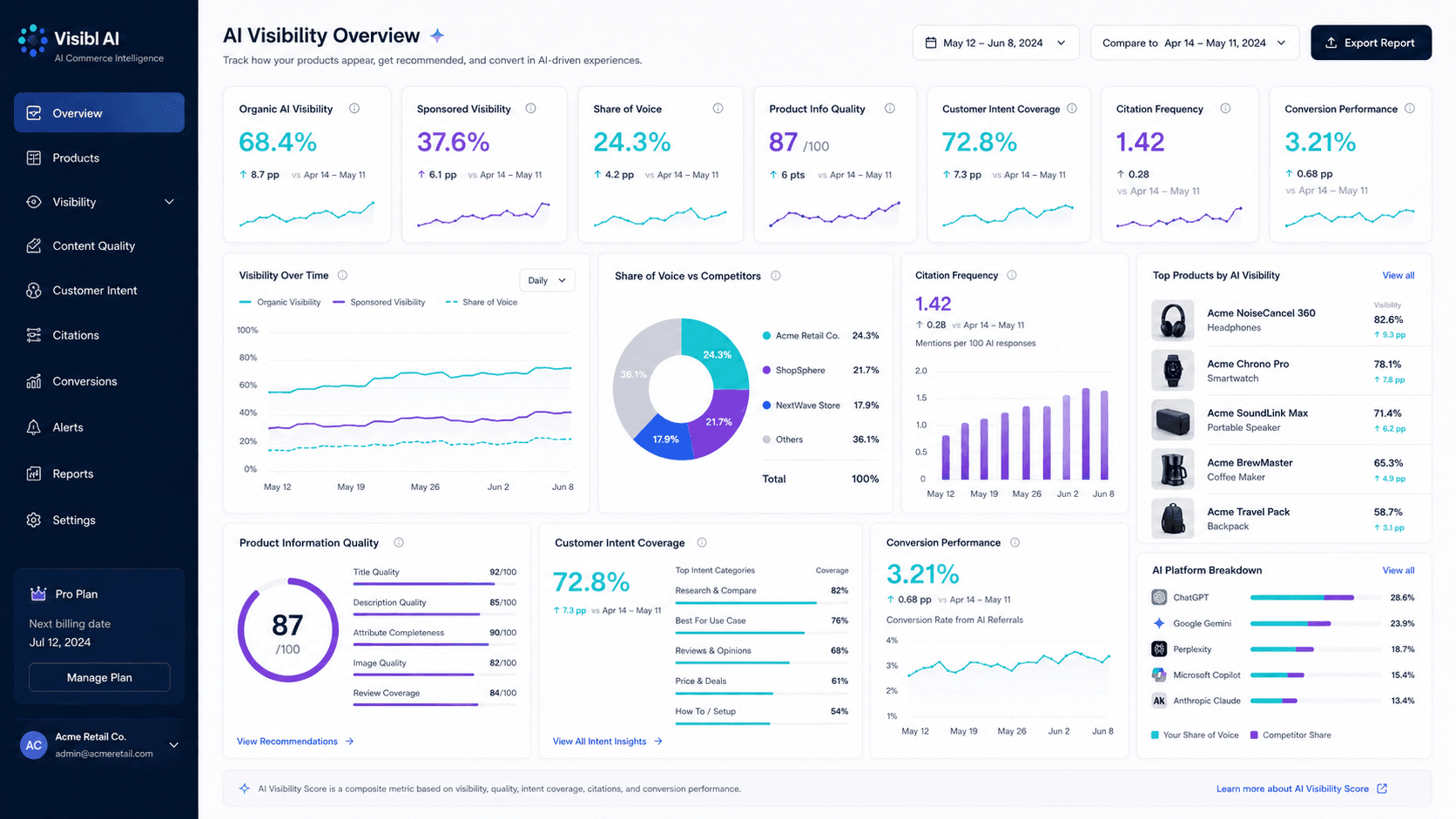
Useful questions include whether the product appears in relevant AI responses, how accurately it is described, which competing products appear alongside it, which customer needs tend to trigger a recommendation, and whether the system understands the product's most important strengths.
This is where XENA SearchPanel is directly relevant. SearchPanel tracks how AI platforms describe and recommend products at the SKU and query level, including visibility, citation frequency, share of voice, and comparisons with competing products.
Instead of assuming that a product is visible because its website ranks well, brands can look at what AI systems are actually saying.
That becomes particularly useful as customers increasingly allow AI systems to do more of the early research on their behalf, a shift explored in XENA's article Your Next Customer Has an AI Buyer.
Content Beyond the Product Page Matters Too
Product data is central to this discussion, but product feeds and product pages are not the only information AI systems can encounter.
Category pages, buying guides, comparison content, FAQs, brand pages, support content, reviews, and educational articles can all provide useful context about what a product does and where it fits.
This makes content strategy more closely connected to ecommerce discovery.
A good article can answer questions that would be awkward to fit inside a product description, while a useful collection page can explain how several products differ before a customer starts comparing individual items.
XENA's guide on choosing whether content should target Google or ChatGPT is useful because not every topic needs the same approach. Some questions still fit traditional search very well, while others depend on enough context that conversational discovery becomes particularly relevant.
Brands should therefore avoid creating hundreds of generic AI focused articles simply because conversational search is growing. The better approach is to strengthen the information customers genuinely need while making sure that information is specific enough to be useful.
What Ecommerce Brands Should Focus on Now
Brands do not need to treat ChatGPT advertising as an emergency budget shift, especially while the advertising ecosystem continues to develop, but they should pay attention to the way product discovery is changing.
The first priority is making product information clear and consistent because AI shopping systems need dependable information before they can make useful distinctions between products.
The next priority is understanding customer intent in more detail. Traditional keyword research still has value, but reviews, support questions, return reasons, product comparisons, customer service conversations, and on site searches can reveal the language people use when describing what they actually need.
Brands should also separate paid visibility from organic AI visibility when evaluating performance. An advertising campaign can tell the business whether sponsored exposure is producing commercial results, while organic visibility can reveal whether the brand is being understood and recommended in relevant buying situations.
Improving the product experience remains equally important because winning visibility is not the same thing as winning the sale. XENA's work on high converting product listings is a useful place to continue when the next question is how to turn that discovery into stronger product page performance.
For a wider view of how these pieces connect, the XENA Intelligence blog covers AI discovery, ecommerce strategy, PPC, marketplace growth, and product listing performance in more depth.
So, Can You Pay to Be Recommended by ChatGPT?
If “recommended” means being selected organically as part of ChatGPT's shopping results, the answer is no based on OpenAI's current documentation. Organic product results are selected independently from ads.
If the question is whether a brand can pay for product visibility inside ChatGPT, then the answer is yes because sponsored placements provide a separate route into relevant conversations.
The difference between those two answers is exactly why this development matters.
Brands now have to think about both earned relevance and paid exposure within conversational commerce, while understanding that each serves a different purpose.
The organic side depends heavily on whether product and brand information give AI systems enough context to understand the offer. The paid side provides another opportunity to reach people who are already discussing needs that may relate to the advertiser's products.
The strongest strategy is unlikely to involve choosing one and ignoring the other.
Instead, brands will need to improve the quality of their product information, understand which customer needs their products genuinely satisfy, monitor how AI systems describe them, and decide where paid exposure adds enough value to justify the investment.
That is a more useful way to think about ChatGPT commerce than asking whether a brand can simply pay to become the recommended answer.
You cannot buy organic relevance, but you can become easier to understand, easier to compare, and more likely to belong in the conversation. When that foundation is strong, paid visibility can play the role it should have played all along: extending reach rather than trying to replace relevance.