
View More Blogs

Product Listings

How to Build High-Converting Product Listings in 2026

Why High-Converting Product Listings Are Built, Not Written

Product Listings Are No Longer Just Content

For years, product listings were treated as static content. Write a decent title, add a few keywords, upload images, and move on. That approach no longer works. In 2026, product listings are living assets that continuously influence discoverability, conversion rate, and ad efficiency.

Shoppers today compare faster, scroll less, and abandon quicker. Every word, image, and data point on a listing either moves them closer to purchase or pushes them away. This is why listing optimization has evolved from copywriting into a performance discipline, similar to what we discussed earlier in Why Conversion Rate Optimization Starts Before the Checkout Page.

Search Intent Is the Foundation of Every High-Performing Listing

High-converting listings start with intent, not keywords. Search intent explains why a shopper is searching, what problem they are trying to solve, and how close they are to making a decision.

A listing optimized for broad discovery intent should educate and differentiate. A listing optimized for high purchase intent should reduce friction and reinforce trust. When brands fail to align listings with intent, traffic increases but conversions stall. This disconnect is closely tied to insights from How Ecommerce Brands Lose Revenue Despite High Traffic, where visibility without relevance creates false growth signals.

Modern listing optimization requires mapping content sections to intent stages instead of stuffing keywords into templates.
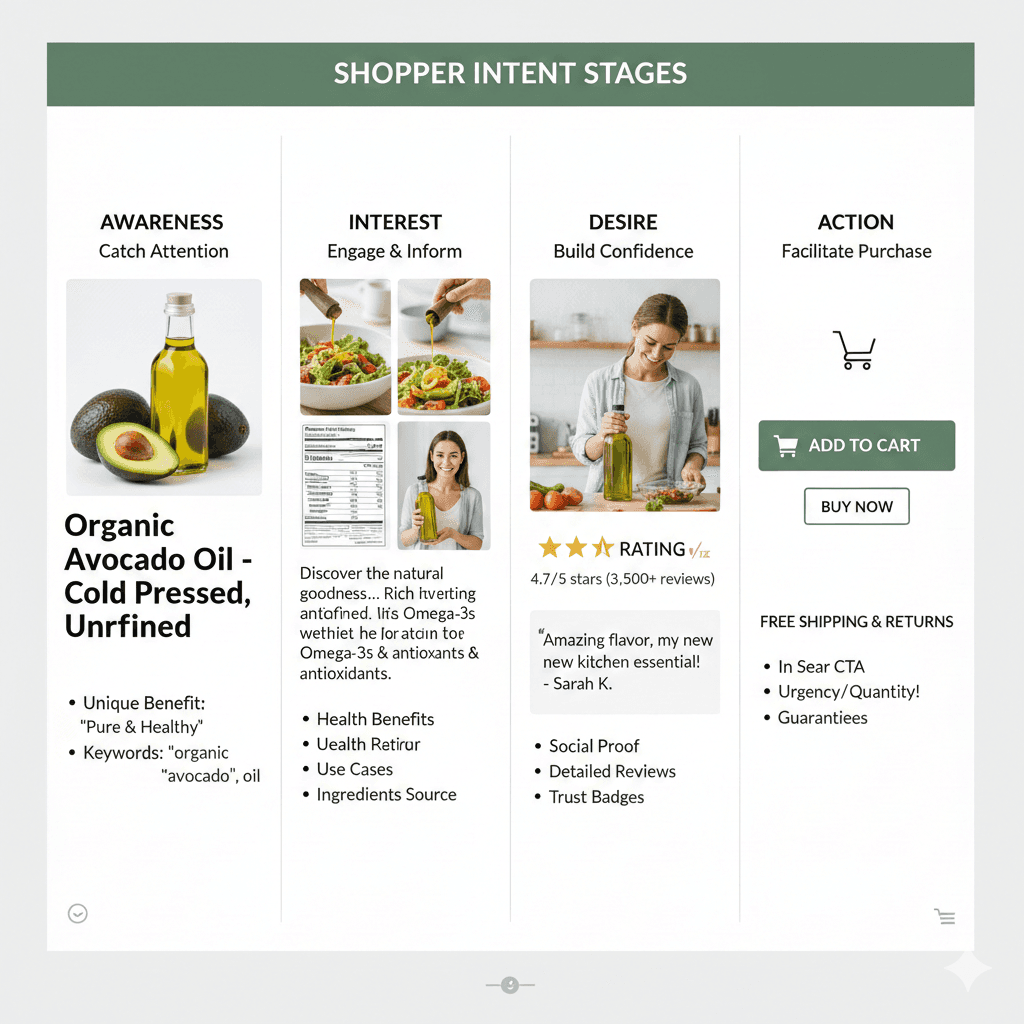

Product listing anatomy showing title, images, bullet content, A plus modules, and reviews mapped to shopper intent

Visual Hierarchy Drives Faster Decisions

Images now carry more conversion weight than copy. Shoppers scan visuals first, especially on mobile. The order, clarity, and storytelling of images influence perceived quality within seconds.

High-performing listings use a clear visual hierarchy. The first image establishes trust. The next explains usage. Follow-up images remove objections and demonstrate differentiation. Lifestyle imagery, comparison visuals, and close-up detail shots each play a specific role.

This visual-first behavior connects strongly with themes covered in How Visual Merchandising Impacts Ecommerce Conversion Rates, where brands that design listings visually outperform those that rely on text-heavy explanations.

AI Is Changing How Listings Are Optimized

Manual listing updates struggle to keep pace with changing demand, seasonality, and competition. AI-driven optimization now allows listings to evolve continuously based on real shopper behavior.

Advanced systems analyze search term shifts, click-through rates, conversion patterns, and competitor movements to recommend or deploy listing updates. Titles adjust. Descriptions refine. Image sequencing improves. This is no longer guesswork.

XENA Intelligence applies predictive analytics to understand how listing changes affect downstream metrics like ad efficiency and inventory velocity, ensuring listings support growth instead of becoming bottlenecks. These ideas align closely with How Predictive Analytics Is Transforming Ecommerce Decision Making.
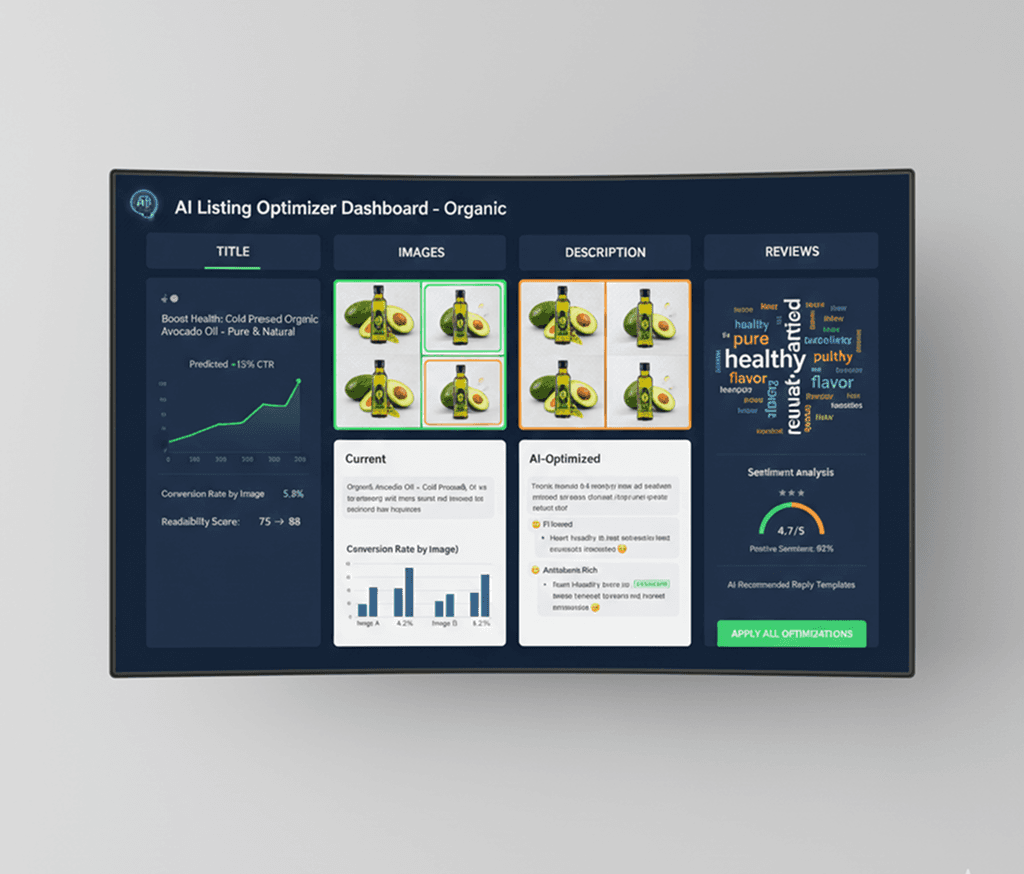

AI-powered dashboard optimizing product listing elements in real time

Listings and Paid Ads Must Work as One System

One of the biggest mistakes brands make is treating listings and paid ads as separate efforts. Ads drive traffic, but listings close the sale. When the two are misaligned, ad costs rise and performance declines.

High-performing brands optimize listings specifically for paid traffic. Messaging matches ad promises. Images reinforce targeting angles. Keywords align with bid strategy. This integrated approach mirrors the lessons from Why PPC Performance Depends on Listing Quality, where conversion-ready listings consistently reduce cost per acquisition.

In 2026, listings are not just organic assets. They are paid media conversion engines.

Reviews, Social Proof, and Trust Signals Matter More Than Ever

Shoppers increasingly rely on reviews, ratings, and visual proof before committing. Listings that surface trust signals early outperform those that bury them.

This includes highlighting review snippets visually, addressing common concerns directly in imagery or copy, and using comparison elements that reinforce credibility. Trust reduces hesitation and hesitation kills conversion.

These behavioral patterns align with insights from How Customer Feedback Shapes Ecommerce Growth, where brands that actively integrate social proof into listings see compounding performance gains.
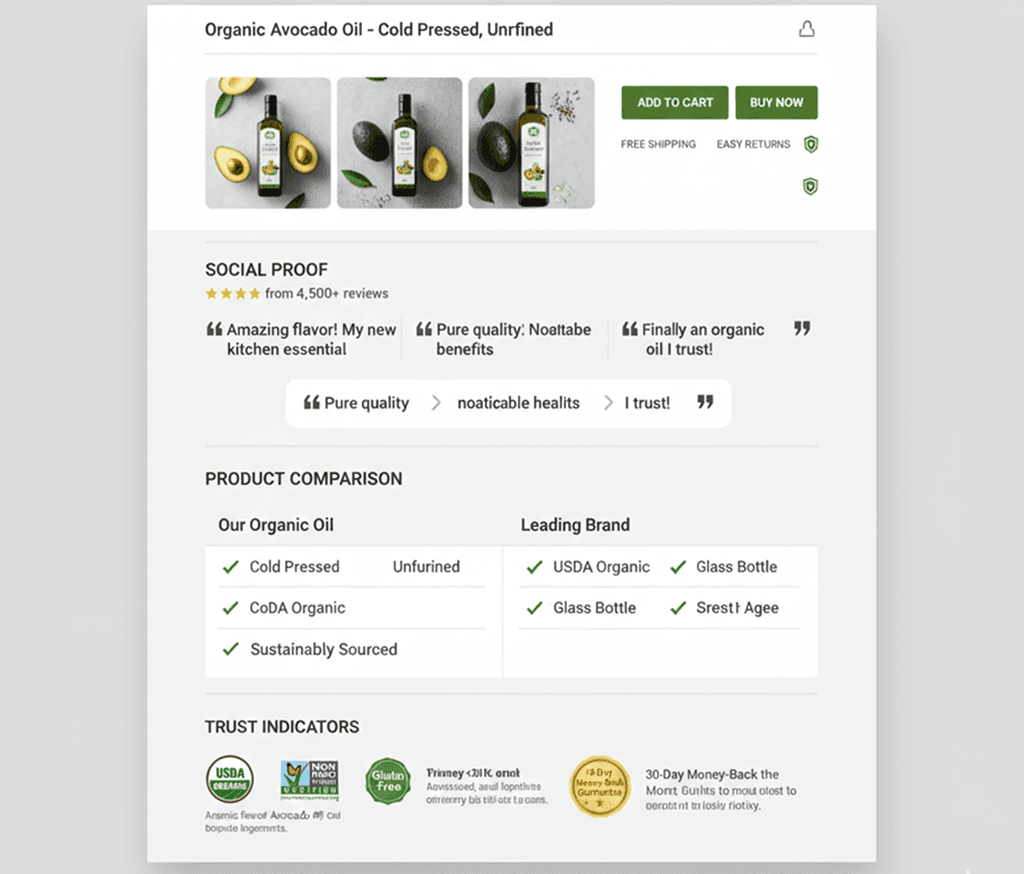

Product listing with highlighted reviews, trust badges, and comparison visuals

The Future of Product Listings Is Continuous Optimization

Product listings are no longer something you finish and forget. They require constant refinement based on search behavior, competition, and performance data. Brands that treat listings as dynamic assets outperform those relying on one-time optimization.

In 2026, the best listings are built through iteration, powered by data, and refined by AI. They evolve with demand, support paid campaigns, and remove friction at every stage of the buyer journey.

Listings are not just pages. They are growth engines.

Product Listings Are No Longer Just Content

For years, product listings were treated as static content. Write a decent title, add a few keywords, upload images, and move on. That approach no longer works. In 2026, product listings are living assets that continuously influence discoverability, conversion rate, and ad efficiency.

Shoppers today compare faster, scroll less, and abandon quicker. Every word, image, and data point on a listing either moves them closer to purchase or pushes them away. This is why listing optimization has evolved from copywriting into a performance discipline, similar to what we discussed earlier in Why Conversion Rate Optimization Starts Before the Checkout Page.

Search Intent Is the Foundation of Every High-Performing Listing

High-converting listings start with intent, not keywords. Search intent explains why a shopper is searching, what problem they are trying to solve, and how close they are to making a decision.

A listing optimized for broad discovery intent should educate and differentiate. A listing optimized for high purchase intent should reduce friction and reinforce trust. When brands fail to align listings with intent, traffic increases but conversions stall. This disconnect is closely tied to insights from How Ecommerce Brands Lose Revenue Despite High Traffic, where visibility without relevance creates false growth signals.

Modern listing optimization requires mapping content sections to intent stages instead of stuffing keywords into templates.


Product listing anatomy showing title, images, bullet content, A plus modules, and reviews mapped to shopper intent

Visual Hierarchy Drives Faster Decisions

Images now carry more conversion weight than copy. Shoppers scan visuals first, especially on mobile. The order, clarity, and storytelling of images influence perceived quality within seconds.

High-performing listings use a clear visual hierarchy. The first image establishes trust. The next explains usage. Follow-up images remove objections and demonstrate differentiation. Lifestyle imagery, comparison visuals, and close-up detail shots each play a specific role.

This visual-first behavior connects strongly with themes covered in How Visual Merchandising Impacts Ecommerce Conversion Rates, where brands that design listings visually outperform those that rely on text-heavy explanations.

AI Is Changing How Listings Are Optimized

Manual listing updates struggle to keep pace with changing demand, seasonality, and competition. AI-driven optimization now allows listings to evolve continuously based on real shopper behavior.

Advanced systems analyze search term shifts, click-through rates, conversion patterns, and competitor movements to recommend or deploy listing updates. Titles adjust. Descriptions refine. Image sequencing improves. This is no longer guesswork.

XENA Intelligence applies predictive analytics to understand how listing changes affect downstream metrics like ad efficiency and inventory velocity, ensuring listings support growth instead of becoming bottlenecks. These ideas align closely with How Predictive Analytics Is Transforming Ecommerce Decision Making.


AI-powered dashboard optimizing product listing elements in real time

Listings and Paid Ads Must Work as One System

One of the biggest mistakes brands make is treating listings and paid ads as separate efforts. Ads drive traffic, but listings close the sale. When the two are misaligned, ad costs rise and performance declines.

High-performing brands optimize listings specifically for paid traffic. Messaging matches ad promises. Images reinforce targeting angles. Keywords align with bid strategy. This integrated approach mirrors the lessons from Why PPC Performance Depends on Listing Quality, where conversion-ready listings consistently reduce cost per acquisition.

In 2026, listings are not just organic assets. They are paid media conversion engines.

Reviews, Social Proof, and Trust Signals Matter More Than Ever

Shoppers increasingly rely on reviews, ratings, and visual proof before committing. Listings that surface trust signals early outperform those that bury them.

This includes highlighting review snippets visually, addressing common concerns directly in imagery or copy, and using comparison elements that reinforce credibility. Trust reduces hesitation and hesitation kills conversion.

These behavioral patterns align with insights from How Customer Feedback Shapes Ecommerce Growth, where brands that actively integrate social proof into listings see compounding performance gains.


Product listing with highlighted reviews, trust badges, and comparison visuals

The Future of Product Listings Is Continuous Optimization

Product listings are no longer something you finish and forget. They require constant refinement based on search behavior, competition, and performance data. Brands that treat listings as dynamic assets outperform those relying on one-time optimization.

In 2026, the best listings are built through iteration, powered by data, and refined by AI. They evolve with demand, support paid campaigns, and remove friction at every stage of the buyer journey.

Listings are not just pages. They are growth engines.

Product Listings Are No Longer Just Content

For years, product listings were treated as static content. Write a decent title, add a few keywords, upload images, and move on. That approach no longer works. In 2026, product listings are living assets that continuously influence discoverability, conversion rate, and ad efficiency.

Shoppers today compare faster, scroll less, and abandon quicker. Every word, image, and data point on a listing either moves them closer to purchase or pushes them away. This is why listing optimization has evolved from copywriting into a performance discipline, similar to what we discussed earlier in Why Conversion Rate Optimization Starts Before the Checkout Page.

Search Intent Is the Foundation of Every High-Performing Listing

High-converting listings start with intent, not keywords. Search intent explains why a shopper is searching, what problem they are trying to solve, and how close they are to making a decision.

A listing optimized for broad discovery intent should educate and differentiate. A listing optimized for high purchase intent should reduce friction and reinforce trust. When brands fail to align listings with intent, traffic increases but conversions stall. This disconnect is closely tied to insights from How Ecommerce Brands Lose Revenue Despite High Traffic, where visibility without relevance creates false growth signals.

Modern listing optimization requires mapping content sections to intent stages instead of stuffing keywords into templates.


Product listing anatomy showing title, images, bullet content, A plus modules, and reviews mapped to shopper intent

Visual Hierarchy Drives Faster Decisions

Images now carry more conversion weight than copy. Shoppers scan visuals first, especially on mobile. The order, clarity, and storytelling of images influence perceived quality within seconds.

High-performing listings use a clear visual hierarchy. The first image establishes trust. The next explains usage. Follow-up images remove objections and demonstrate differentiation. Lifestyle imagery, comparison visuals, and close-up detail shots each play a specific role.

This visual-first behavior connects strongly with themes covered in How Visual Merchandising Impacts Ecommerce Conversion Rates, where brands that design listings visually outperform those that rely on text-heavy explanations.

AI Is Changing How Listings Are Optimized

Manual listing updates struggle to keep pace with changing demand, seasonality, and competition. AI-driven optimization now allows listings to evolve continuously based on real shopper behavior.

Advanced systems analyze search term shifts, click-through rates, conversion patterns, and competitor movements to recommend or deploy listing updates. Titles adjust. Descriptions refine. Image sequencing improves. This is no longer guesswork.

XENA Intelligence applies predictive analytics to understand how listing changes affect downstream metrics like ad efficiency and inventory velocity, ensuring listings support growth instead of becoming bottlenecks. These ideas align closely with How Predictive Analytics Is Transforming Ecommerce Decision Making.


AI-powered dashboard optimizing product listing elements in real time

Listings and Paid Ads Must Work as One System

One of the biggest mistakes brands make is treating listings and paid ads as separate efforts. Ads drive traffic, but listings close the sale. When the two are misaligned, ad costs rise and performance declines.

High-performing brands optimize listings specifically for paid traffic. Messaging matches ad promises. Images reinforce targeting angles. Keywords align with bid strategy. This integrated approach mirrors the lessons from Why PPC Performance Depends on Listing Quality, where conversion-ready listings consistently reduce cost per acquisition.

In 2026, listings are not just organic assets. They are paid media conversion engines.

Reviews, Social Proof, and Trust Signals Matter More Than Ever

Shoppers increasingly rely on reviews, ratings, and visual proof before committing. Listings that surface trust signals early outperform those that bury them.

This includes highlighting review snippets visually, addressing common concerns directly in imagery or copy, and using comparison elements that reinforce credibility. Trust reduces hesitation and hesitation kills conversion.

These behavioral patterns align with insights from How Customer Feedback Shapes Ecommerce Growth, where brands that actively integrate social proof into listings see compounding performance gains.


Product listing with highlighted reviews, trust badges, and comparison visuals

The Future of Product Listings Is Continuous Optimization

Product listings are no longer something you finish and forget. They require constant refinement based on search behavior, competition, and performance data. Brands that treat listings as dynamic assets outperform those relying on one-time optimization.

In 2026, the best listings are built through iteration, powered by data, and refined by AI. They evolve with demand, support paid campaigns, and remove friction at every stage of the buyer journey.

Listings are not just pages. They are growth engines.
Product Listings Are No Longer Just Content

For years, product listings were treated as static content. Write a decent title, add a few keywords, upload images, and move on. That approach no longer works. In 2026, product listings are living assets that continuously influence discoverability, conversion rate, and ad efficiency.

Shoppers today compare faster, scroll less, and abandon quicker. Every word, image, and data point on a listing either moves them closer to purchase or pushes them away. This is why listing optimization has evolved from copywriting into a performance discipline, similar to what we discussed earlier in Why Conversion Rate Optimization Starts Before the Checkout Page.

Search Intent Is the Foundation of Every High-Performing Listing

High-converting listings start with intent, not keywords. Search intent explains why a shopper is searching, what problem they are trying to solve, and how close they are to making a decision.

A listing optimized for broad discovery intent should educate and differentiate. A listing optimized for high purchase intent should reduce friction and reinforce trust. When brands fail to align listings with intent, traffic increases but conversions stall. This disconnect is closely tied to insights from How Ecommerce Brands Lose Revenue Despite High Traffic, where visibility without relevance creates false growth signals.

Modern listing optimization requires mapping content sections to intent stages instead of stuffing keywords into templates.


Product listing anatomy showing title, images, bullet content, A plus modules, and reviews mapped to shopper intent

Visual Hierarchy Drives Faster Decisions

Images now carry more conversion weight than copy. Shoppers scan visuals first, especially on mobile. The order, clarity, and storytelling of images influence perceived quality within seconds.

High-performing listings use a clear visual hierarchy. The first image establishes trust. The next explains usage. Follow-up images remove objections and demonstrate differentiation. Lifestyle imagery, comparison visuals, and close-up detail shots each play a specific role.

This visual-first behavior connects strongly with themes covered in How Visual Merchandising Impacts Ecommerce Conversion Rates, where brands that design listings visually outperform those that rely on text-heavy explanations.

AI Is Changing How Listings Are Optimized

Manual listing updates struggle to keep pace with changing demand, seasonality, and competition. AI-driven optimization now allows listings to evolve continuously based on real shopper behavior.

Advanced systems analyze search term shifts, click-through rates, conversion patterns, and competitor movements to recommend or deploy listing updates. Titles adjust. Descriptions refine. Image sequencing improves. This is no longer guesswork.

XENA Intelligence applies predictive analytics to understand how listing changes affect downstream metrics like ad efficiency and inventory velocity, ensuring listings support growth instead of becoming bottlenecks. These ideas align closely with How Predictive Analytics Is Transforming Ecommerce Decision Making.


AI-powered dashboard optimizing product listing elements in real time

Listings and Paid Ads Must Work as One System

One of the biggest mistakes brands make is treating listings and paid ads as separate efforts. Ads drive traffic, but listings close the sale. When the two are misaligned, ad costs rise and performance declines.

High-performing brands optimize listings specifically for paid traffic. Messaging matches ad promises. Images reinforce targeting angles. Keywords align with bid strategy. This integrated approach mirrors the lessons from Why PPC Performance Depends on Listing Quality, where conversion-ready listings consistently reduce cost per acquisition.

In 2026, listings are not just organic assets. They are paid media conversion engines.

Reviews, Social Proof, and Trust Signals Matter More Than Ever

Shoppers increasingly rely on reviews, ratings, and visual proof before committing. Listings that surface trust signals early outperform those that bury them.

This includes highlighting review snippets visually, addressing common concerns directly in imagery or copy, and using comparison elements that reinforce credibility. Trust reduces hesitation and hesitation kills conversion.

These behavioral patterns align with insights from How Customer Feedback Shapes Ecommerce Growth, where brands that actively integrate social proof into listings see compounding performance gains.


Product listing with highlighted reviews, trust badges, and comparison visuals

The Future of Product Listings Is Continuous Optimization

Product listings are no longer something you finish and forget. They require constant refinement based on search behavior, competition, and performance data. Brands that treat listings as dynamic assets outperform those relying on one-time optimization.

In 2026, the best listings are built through iteration, powered by data, and refined by AI. They evolve with demand, support paid campaigns, and remove friction at every stage of the buyer journey.

Listings are not just pages. They are growth engines.

Ready to Take Your E-Commerce Growth to the Next Level?

Discover how XENA helps brands and sellers optimize listings, boost visibility, and stay ahead in competitive marketplaces.

Book a Meeting

2025 XENA Intelligence Inc.

Louisville, Kentucky

2025 XENA Intelligence Inc.

Louisville, Kentucky