AEO Has Moved From Trend to Daily Reality
For years, D2C sellers built growth around SEO, paid ads, influencer campaigns, email flows, and marketplace optimization. That work still matters. The entry point, though, is shifting.
Shoppers are not only typing short keywords into search bars anymore. They are asking detailed questions. They are comparing products through AI assistants. They expect product summaries, price context, buying guidance, and personalized recommendations without digging through multiple pages.
That is where AEO becomes important.
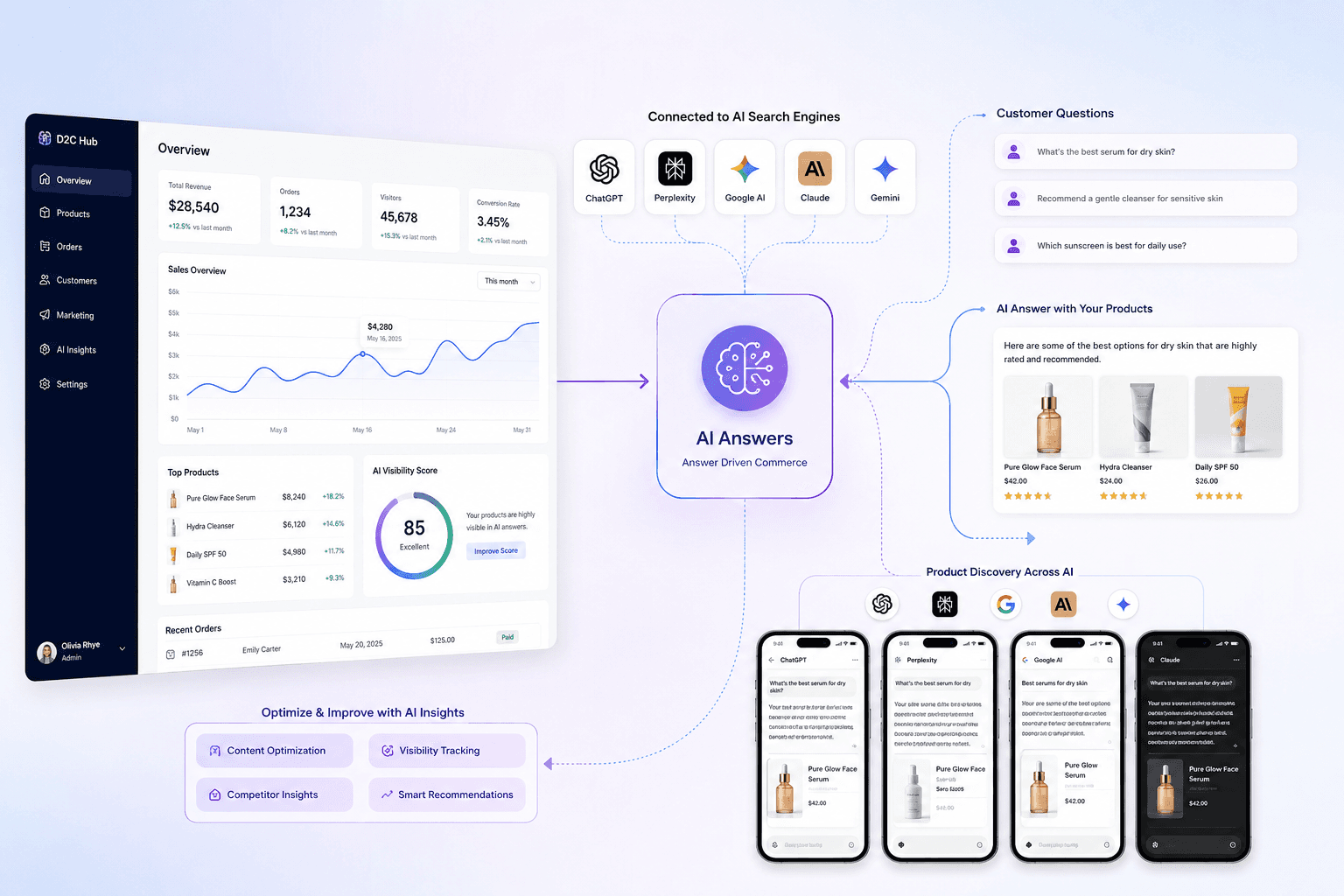
AEO, or Answer Engine Optimization, means shaping your brand, product pages, listings, reviews, content, and data so AI powered answer engines can understand them clearly and recommend them with confidence.
Put simply, SEO helps your brand appear on search results pages. AEO helps your brand become part of the answer.
For D2C sellers, this matters because the shopper journey is becoming shorter and harder to predict. A customer may first discover your brand through an AI generated response, not through your website, social profile, or marketplace listing.
The Technology Shift Behind AEO
The real change is not just that AI tools exist. The bigger shift is that AI is now moving directly into the buying journey.
Google announced in January 2026 that agentic commerce, where AI can complete tasks for shoppers, is moving closer to everyday use. Its Universal Commerce Protocol is designed to support discovery, purchase, and post purchase support across AI surfaces. Eligible product listings in AI Mode and the Gemini app are expected to support checkout from those experiences.
Google has also tested new ad formats for AI Mode and Search. These include Conversational Discovery ads, Highlighted Answers, and AI powered Shopping ads that use Gemini to explain why a product may fit a shopper’s query.
OpenAI introduced shopping research in ChatGPT in November 2025. The experience asks clarifying questions, searches across the web, and builds personalized buyer guides for product decisions. OpenAI also stated that hundreds of millions of people use ChatGPT to find, understand, and compare products.
For merchants, ChatGPT now offers a dedicated product discovery route. Brands can share product feeds so their products may appear when shoppers are actively evaluating what to buy. The merchant page also says shoppers can browse rich product results with images, prices, and key details, while sellers can direct shoppers to their own site or app by default.
Google Merchant Center is moving in the same direction. On May 27, 2026, Google announced AI performance insights to help brands understand how products are discovered across AI Mode, AI Overviews in Search, and the Gemini app.
The signal is clear for D2C sellers. Product discovery is becoming conversational. It is answer led. It depends heavily on clean, detailed data.
Why D2C Sellers Feel This Shift More Directly
D2C brands have always valued control over the customer relationship. The website mattered. So did the product page, the brand story, the email list, the landing page, and the subscription flow.
AEO changes where the relationship begins.
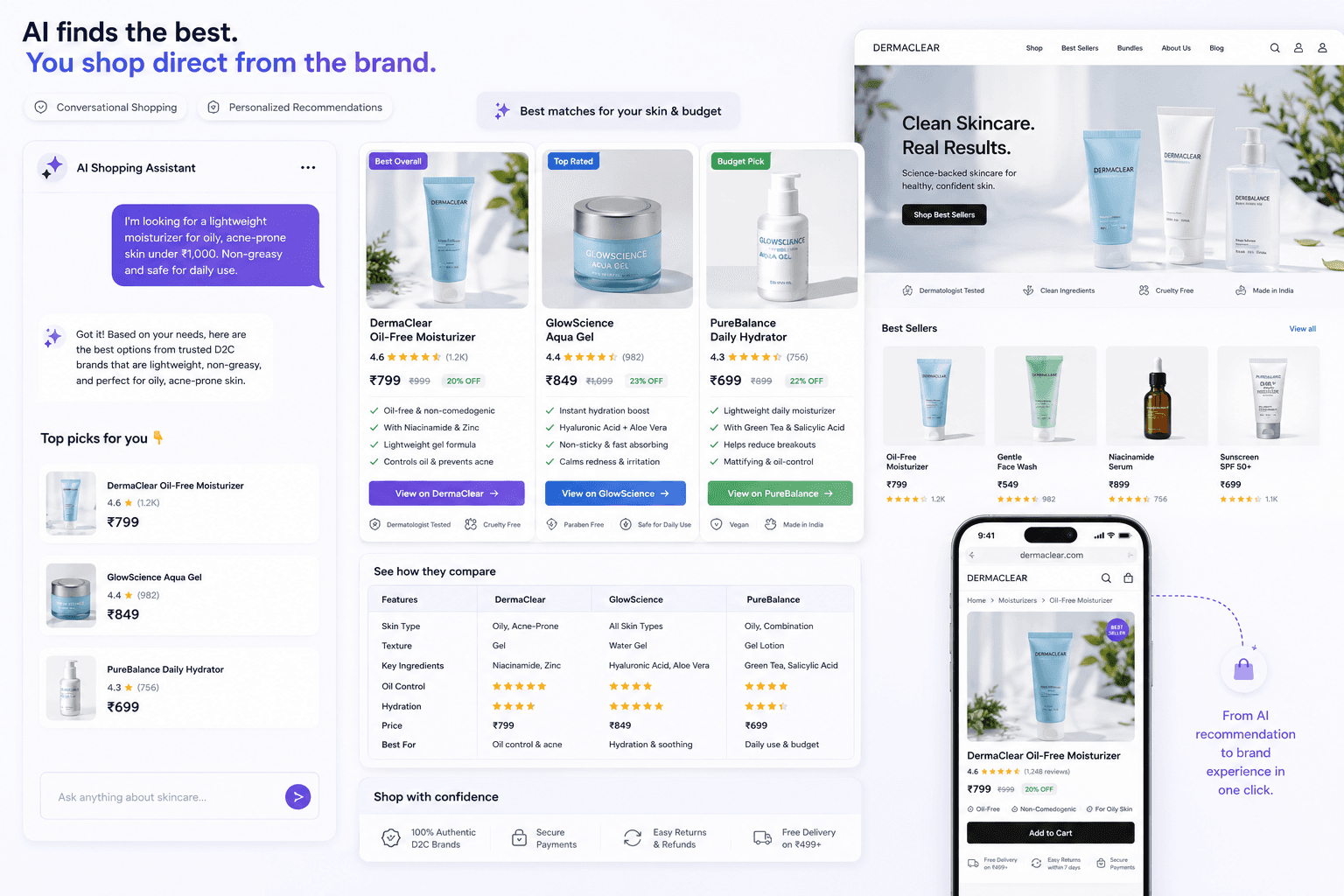
A shopper may ask an AI assistant, “What is the best non-sticky sunscreen for oily skin under $25?” Another might ask, “Which protein powder has clean ingredients and is less likely to cause bloating?” Someone else may search for a sustainable baby care brand with fragrance free products.
The answer engine can summarize brands, compare features, show prices, surface reviews, and guide the shopper toward a recommendation before your website ever receives a click.
That does not mean D2C sellers lose control. It means they need to send clearer signals into the new discovery layer.
Thin product data makes your brand harder to understand. Vague benefits make it harder to recommend. Scattered reviews, missing FAQs, and generic content give AI systems less useful material to work with.
This connects closely with XENA’s thinking in How to Build High Converting Product Listings in 2026. Product pages are no longer simple sales pages. They now act as structured information hubs that influence discovery, conversion, and ad performance.
From Keywords to Real Questions
Traditional SEO trained sellers to target phrases like “best running shoes” or “organic face wash.” AEO pushes the work closer to shopper intent.
AI search reads context. It pays attention to needs, limits, preferences, and tradeoffs. A shopper may not search for “ceramic cookware.” They may ask, “What is a safe non toxic cookware set for a small apartment that works on induction?”
That one question reveals a lot. The shopper cares about safety. They have limited space. Their stove type matters. They are likely close to buying.
D2C sellers need content that answers questions like this directly. Product pages, blogs, comparison pages, FAQs, and guides should explain how the product works, who it suits, what problem it solves, where it may not be the best fit, and how it compares to other options.
This is where AEO becomes practical. A brand that explains clearly is easier for AI to summarize. A brand that structures product details well gives answer engines stronger material to trust. A brand that answers real buying questions has a better chance of appearing when those questions become prompts.
For sellers improving product data, XENA’s guide on Attribute Rich Listings That Rank and Convert in 2025 fits naturally into this conversation. Attributes are no longer just filters on marketplaces. They are machine readable signals that help answer engines match products to specific shopper needs.
Product Feeds Are Turning Into Visibility Assets
In older ecommerce workflows, product feeds were often treated like backend plumbing. Titles, images, prices, availability, categories, and descriptions were sent into ad platforms or marketplaces because the system required them.
That mindset is outdated.
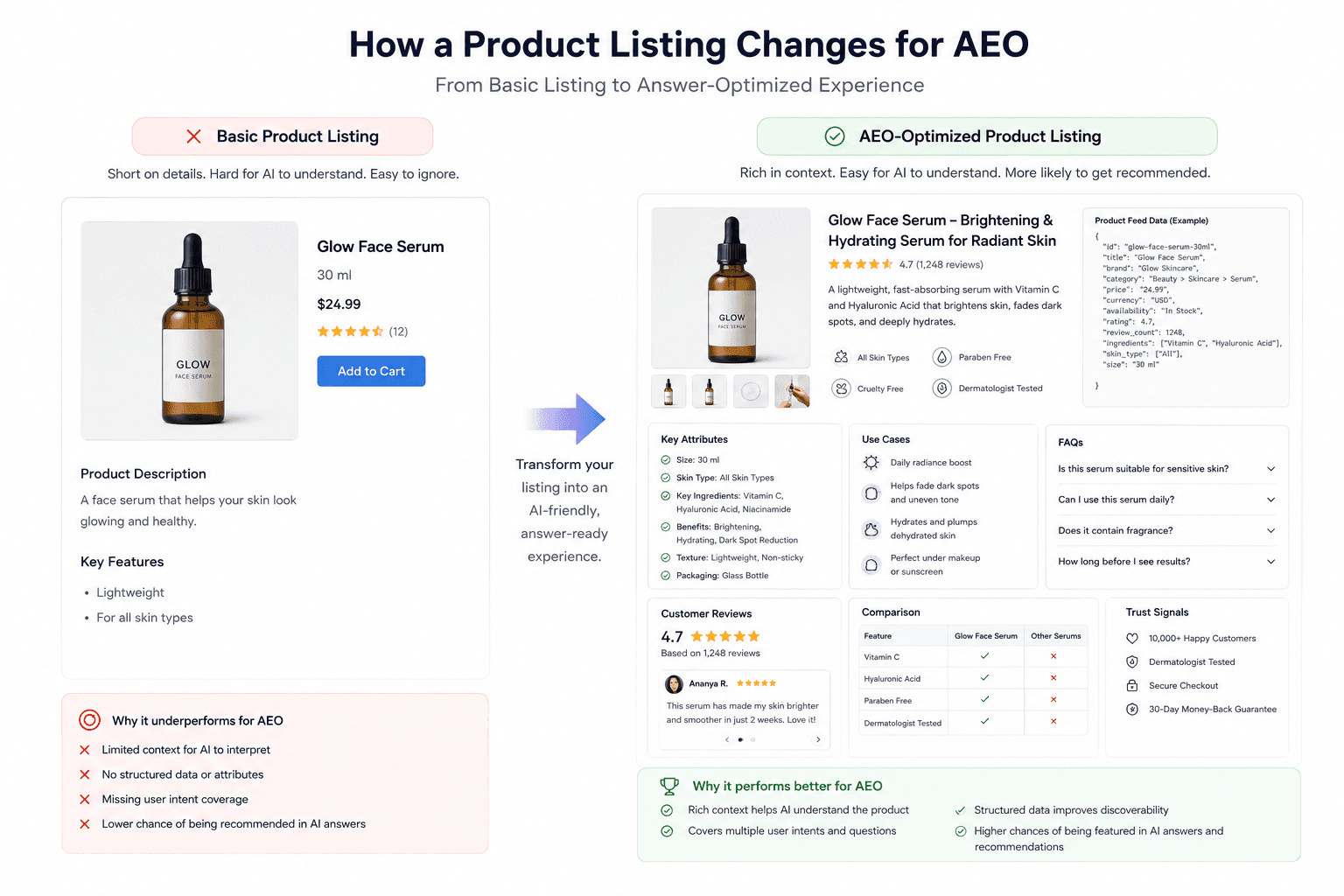
In an AEO environment, product feeds carry strategic value. AI shopping systems need structured data to recommend products accurately. They need to understand what the product is, what it costs, who it is for, what it is made from, whether it is available, how variants differ, what customers say, and why someone might choose it.
A feed cannot be an afterthought.
Take a D2C skincare brand. “Hydrating moisturizer” is not enough. The data should make it clear whether the formula is fragrance free, non comedogenic, suitable for sensitive skin, pregnancy friendly, vegan, refillable, travel sized, dermatologist tested, or designed for a specific routine.
A food brand should clarify allergens, protein source, sugar level, serving size, dietary fit, certifications, and use case.
A fashion brand should clean up size, fit, fabric, care instructions, occasion, sustainability claims, and return details.
When AI engines compare products, this kind of clarity can decide whether a brand gets recommended or ignored.
AEO Will Change Product Listings
AEO will force sellers to rethink listings from both a human and machine perspective.
A strong listing still has to persuade a person. It needs sharp imagery, clear benefits, proof, reviews, and a reason to buy now. It also has to be easy for AI systems to read.
That means product titles should be clear, not overly clever. Descriptions should answer buyer intent instead of repeating generic brand language. FAQs should handle real objections. Images should show use cases. Specifications should be complete. Reviews should be monitored for patterns in customer language. Comparison content should be honest enough to be useful.
This matches the approach in XENA’s Product Listings That Sell: Your Ultimate Guide to E-commerce Success, where the listing is treated as a conversion asset rather than a catalog requirement.
For D2C sellers, this matters because one product page may now serve several audiences at once. It has to convince a shopper. It has to support marketplace visibility. It has to help paid traffic convert. It also has to provide enough structured clarity for answer engines.
AEO Will Reshape Paid Media
Along with affecting organic visibility, AEO affects advertising as well.
Google’s AI powered Shopping ads are designed to create custom explainers that show why a product may be right for a shopper. That means ad relevance will depend on more than bidding and targeting. The quality of product data and creative signals will play a larger role.
This creates a new performance gap for D2C sellers. Brands with clean feeds, strong creative assets, clear benefits, fresh product information, and conversion ready landing pages give AI ad systems better material to work with. Brands with messy data and weak positioning may still pay for traffic, but they may miss the most valuable recommendation moments.
XENA’s Xenalytics and Foresight can support this shift in a practical way. Xenalytics helps sellers identify performance patterns faster. Foresight supports smarter listing and content optimization. In an AEO driven market, sellers cannot afford to wait weeks before realizing their product data, messaging, or ad angles are not matching buyer intent.
For a deeper look at faster optimization cycles, XENA’s article on Agentic AI in E-commerce is a strong next read. AEO rewards brands that can spot change quickly and update their feeds, content, and campaigns before competitors gain ground.
Trust Signals Carry More Weight in AI Answers
AI systems are designed to reduce uncertainty for shoppers. That makes trust signals more important.
For D2C sellers, credibility needs to show up across the full digital footprint. Reviews matter. Ratings matter. Product claims, certifications, shipping policies, return terms, founder story, expert validation, customer photos, and third party mentions can all shape how reliable a brand appears.
Consistency matters just as much.
If your website says a product is “clean,” the product page should explain what that means. If an ad says “clinically tested,” the listing should support the claim. If packaging says “sustainable,” the FAQ should explain materials, sourcing, or impact. AI engines can compare signals across pages and platforms.
That is why brand consistency now has a direct connection to visibility. Every digital asset becomes part of the same answer ecosystem.
XENA’s article on How Xena is Revolutionizing Ecommerce with AI speaks to this broader shift. AI is not only about moving faster. It is about building a smarter operating system for visibility, performance, and growth.
Useful Content Beats Promotional Content
AEO rewards answers that help people make decisions.
Many D2C brands still publish content that sounds polished but does not solve much. A blog titled “Why Our Product Is the Best” rarely helps a shopper. A guide that explains product types, ingredient choices, common mistakes, or buying tradeoffs is far more useful.
Answer engines need content that resolves intent.
A baby care brand can publish guides about fragrance free routines, diaper rash prevention, travel kits, sensitive skin ingredients, and newborn bath safety.
A coffee brand can explain grind size, brewing methods, caffeine levels, roast differences, acidity, subscriptions, and freshness.
A fitness brand can create comparison guides for beginners, athletes, busy parents, weight loss customers, and people with dietary restrictions.
This is not only content marketing. It is answer building.
The more useful your content ecosystem becomes, the easier it is for AI systems to understand your expertise.
The New D2C AEO Guide
Start by checking how your brand appears across answer style searches. Use the kinds of questions your ideal customers would actually ask. Include budgets, use cases, objections, ingredients, comparisons, alternatives, and personal preferences. Look at whether your brand appears, how it is described, and which other brands are being surfaced.
Then improve your product data. Clean up titles, descriptions, variants, attributes, FAQs, image tags, product feeds, pricing, availability, return details, and review themes. AI discovery depends on clarity.
Build content around buyer questions. Do not write only for keywords. Write for the moment when a shopper is confused, comparing options, hesitating, or looking for confidence.
Connect AEO with conversion rate optimization. Visibility is not enough. If an AI answer sends a high intent shopper to your page, that page has to close the sale. It needs strong visuals, fast load speed, clear proof, simple navigation, and a checkout flow that does not create friction.
Keep optimizing. AEO will not be a one time project. Search behavior will shift. AI surfaces will evolve. Ad formats will change. Product data requirements will get more specific. Shopper expectations will keep moving.
This is why XENA’s approach to hourly campaign optimization, predictive analytics, and expert support fits the current environment. D2C brands need faster feedback loops. They need to understand what is changing, why performance is moving, and which action to take next.
For sellers thinking beyond acquisition, XENA’s guide on Ecommerce Customer Retention is also relevant. AEO may help a shopper discover you. Retention systems turn that first AI assisted purchase into repeat revenue.
What D2C Sellers Should Watch Next
The next wave of AEO will go beyond product recommendations.
AI agents will increasingly help shoppers compare subscriptions, reorder products, evaluate reviews, check return policies, apply discounts, and complete purchases. Google’s January 2026 announcement already points toward AI surfaces where eligible shoppers can check out from product listings while retailers remain the seller of record. It also introduces branded AI agents that can answer product questions in Search using a retailer’s own information.
That means D2C brands should prepare for a buying journey where the customer may speak with an AI sales assistant before they land on a brand owned page.
The brands with the advantage will be easy to understand. Easy to recommend. Easy to compare. Easy to buy from.
Final Takeaway
AEO is not replacing SEO, PPC, content marketing, or product listing optimization. It is connecting those efforts through a new discovery layer.
For D2C sellers, the message is direct. Your brand is no longer competing only for rankings, clicks, and impressions. It is competing to be the answer.
That requires better product data, clearer positioning, stronger trust signals, useful content, faster optimization, and smarter AI powered systems behind the scenes.
The next stage of ecommerce will reward brands that explain themselves clearly and move quickly. Sellers who treat AEO as a growth discipline now will be better prepared as AI search, conversational shopping, and agentic commerce become part of everyday buying behavior.