Why 2026 will be the year of applied AI
The hype cycle is over. In 2026, AI shifts from experimental to expected. Brands that win will operationalize three habits. They will let agentic systems do the heavy lifting across ads, content, and merchandising. They will update decisions on an hourly cadence, not weekly. They will pair prediction with guardrails so every change is both fast and safe. Google’s 2025 updates already point the way, with more controls and transparency in Performance Max that let teams keep automation aligned to business goals. That momentum grows from here.
Linking the AI stack to the KPIs that matter
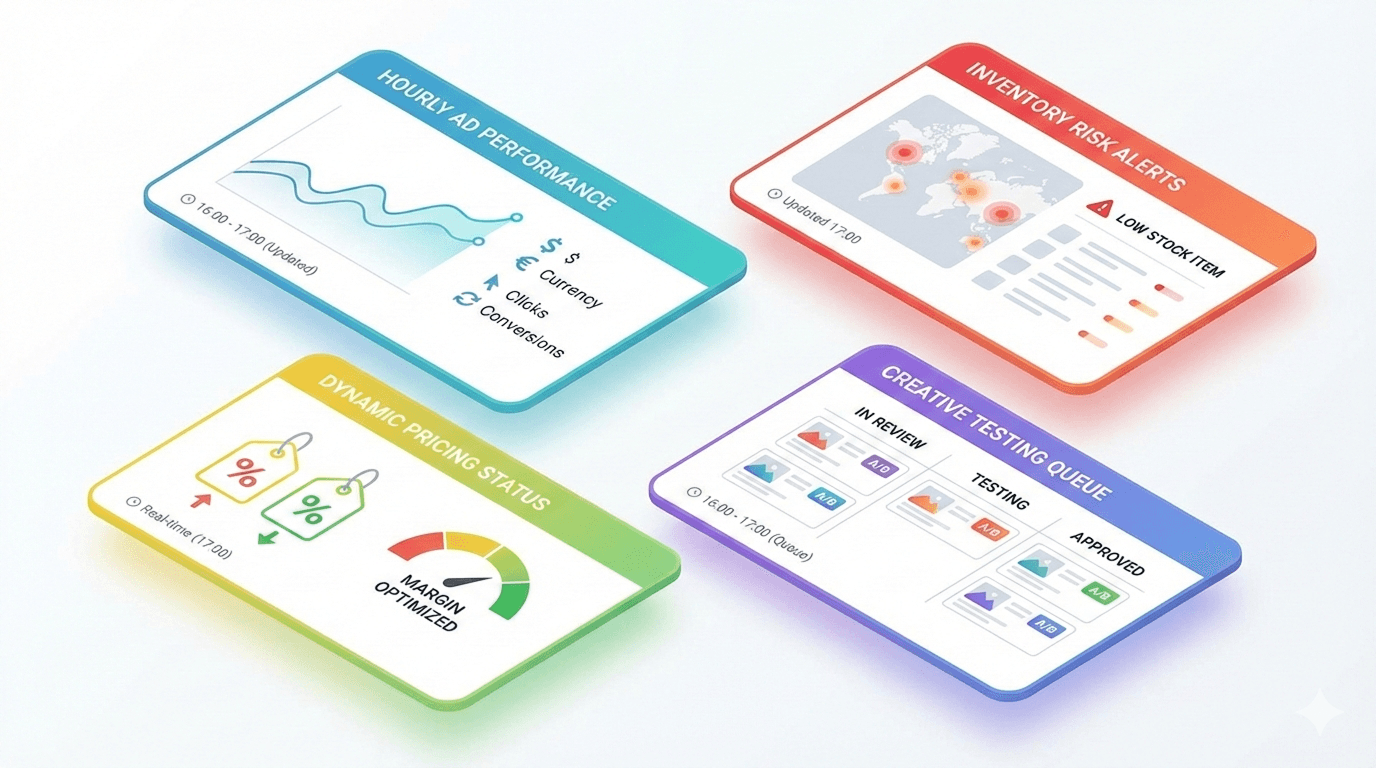
AI is not a magic button. It is a stack that moves three numbers. It raises revenue by matching intent with the right offer and the right creative at the right time. It reduces cost by eliminating waste in bids, audiences, and inventory buffers. It shrinks risk by catching anomalies in pricing, returns, or supply before they hit the P&L. If you want a primer on the building blocks, start with our overview of AI in commerce and then go deeper on how generative systems shape the customer journey. See AI in E-commerce: Applications and Use Cases and Generative AI in E-commerce.
What agentic AI means for a brand team
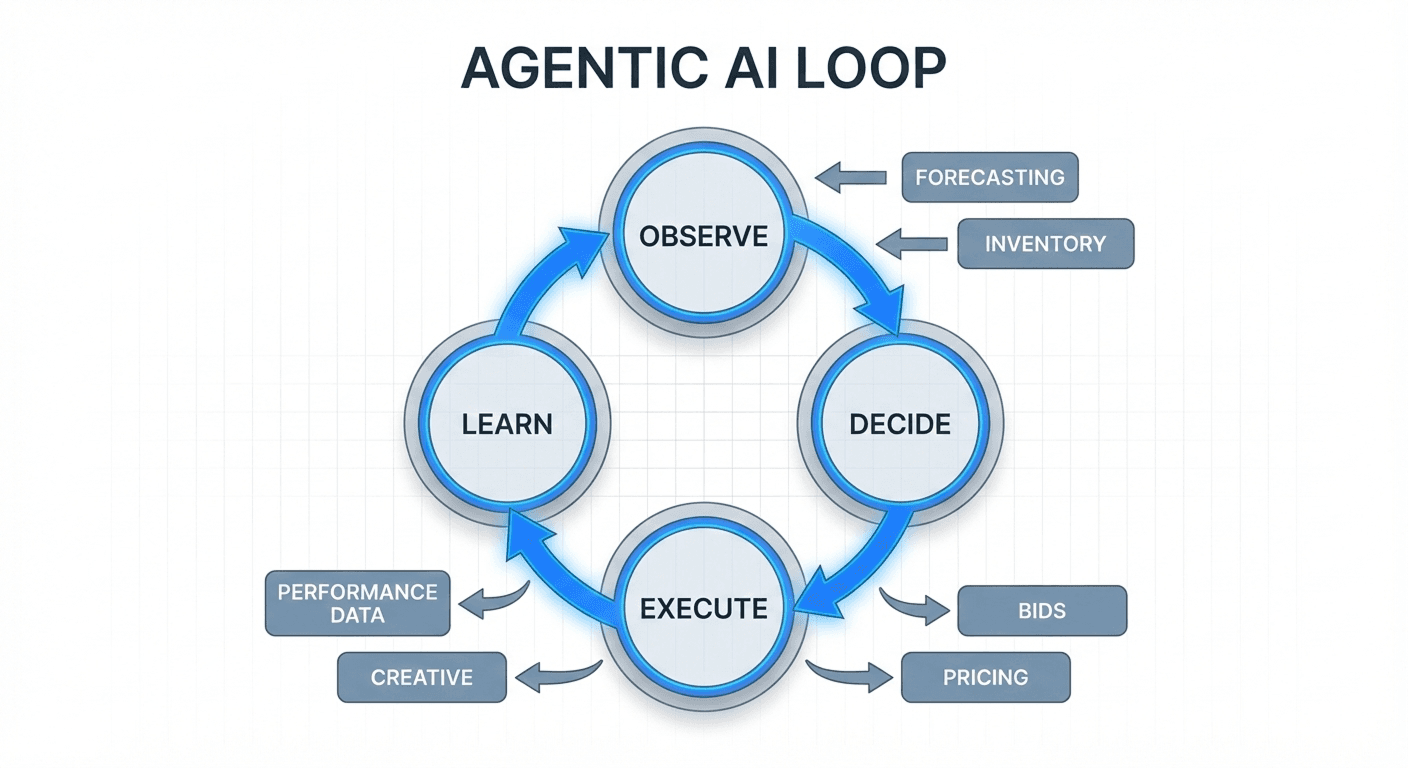
Agentic AI is more than a model that predicts a click or a sale. It is a loop that observes, decides, executes, and learns with minimal hand holding. Adtech players are already funding this direction, where AI agents adjust bids, rotate creative, and scale workflows across channels. That same pattern now moves into retail media and marketplaces where execution speed is the edge.
From daily to hourly: the new operational tempo
Creative fatigue can set in by lunchtime. Competitors can change prices while you are in a meeting. Search and social inventory can swing with a trending video. Your process needs to breathe at that pace. Hourly optimization sounds intense, but it is simply a steady loop. Pull fresh data, test the smallest viable change, and lock wins while rolling back misses. Our guide to Amazon ad automation shows how this cadence looks in practice and how to structure experiments so they scale.
Pricing, but with guardrails
Dynamic pricing is powerful, and it is also under a brighter spotlight. Some retailers already use AI to vary prices based on demand and many micro signals. Regulators and consumers are paying attention, so brands need transparency and fairness policies baked in. Use AI to test elasticity and to protect contribution margin, while maintaining clear rules for when prices can move and by how much. Recent reporting shows why this is important for trust and compliance. Barron's
Store and ops get smarter too
AI does more than market products. It improves store execution and loss prevention, from vision systems that catch mis-scans to computer vision that speeds produce identification. As these capabilities become mainstream, expect inventory accuracy to rise and shrink to fall, which feeds better forecasting for your digital channels. The Sun
A simple roadmap you can start today
Step one: connect predictions to actions
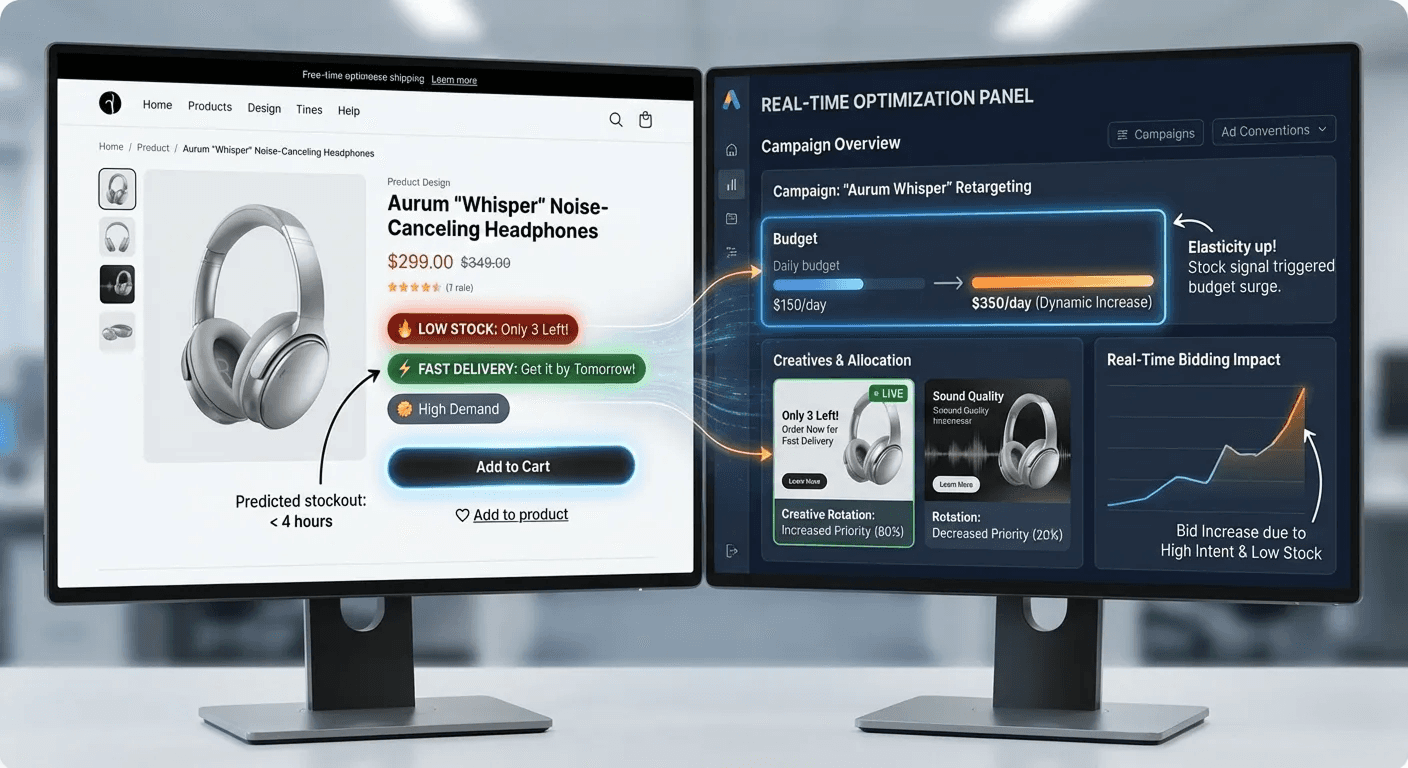
A forecast is only useful if the system can act on it. Tie demand forecasts to your bidding, your promotion calendar, and your inbound POs. If predicted stockouts are flagged, the system should lower bids and raise prices within your limits. If predicted winners emerge, creative and budgets should flex automatically.
Step two: make creative a data product
Treat copy, images, and video as modular assets. Test new hooks and headlines in small batches, then promote winners into your evergreen sets. If you need a practical starting point for listing content, this guide shows how to use conversational AI to upgrade titles, bullets, and descriptions without sacrificing brand voice.
Step three: align automation with channel specifics
Search, social, and marketplace ads do not respond to the same levers. Lean on platform native automation where it is strong, but keep your own rules for brand terms, new customer goals, and margin floors. Google’s latest Performance Max controls demonstrate where platform AI is heading, and why your first party rules still matter.
Step four: close the loop between ads and merchandising
Creative should reflect inventory reality. If a variant is low, shift demand to the alternatives you can fulfill. Use AI to predict returns and show the right size charts or fit tips when risk is high. For a broader tour of the AI landscape, revisit our evolution of AI article, then pull ideas into your playbook.
What to automate vs what to supervise
Automate anything that repeats, that has a clear objective, and that benefits from fast iteration. Bidding and budget pacing are clear fits. Creative rotation is a fit when inputs are high quality and guardrails are firm. Supervise anything that can alter your brand promise, your prices, or your customer privacy. Your team should approve new brand copy templates and any change to sensitive segments. McKinsey’s retail insights continue to show that brands that pair automation with human judgment outperform on both growth and cost. McKinsey & Company
How XENA makes this work in the real world
XENA is built around the loop you need. Hourly campaign optimization keeps bids and budgets aligned with live intent. Predictive analytics surfaces stockouts, elasticities, and likely returns before they cost you. Our expert layer keeps brand safety and policy intact. If you want to see how this cadence plays with Amazon specifically, start with our walkthrough on ad automation, then explore how AI reshapes listing quality and on-page relevance.
Further reading from the XENA blog
Dig into AI in E-commerce: Applications and Use Cases, The Evolution of AI in E-commerce, and Generative AI in E-commerce for a deeper strategy view. If you are tuning ads this quarter, Streamlining Success with Amazon Ad Automation will help you map experiments to business goals.
Conclusion: Make 2026 your year of applied AI
The winners next year will not be those who talk about AI. They will be the teams who wire prediction into action, who learn every hour, and who keep customers at the center with clear guardrails. Start small, ship fast, and let the loop compound.
Why 2026 will be the year of applied AI
The hype cycle is over. In 2026, AI shifts from experimental to expected. Brands that win will operationalize three habits. They will let agentic systems do the heavy lifting across ads, content, and merchandising. They will update decisions on an hourly cadence, not weekly. They will pair prediction with guardrails so every change is both fast and safe. Google’s 2025 updates already point the way, with more controls and transparency in Performance Max that let teams keep automation aligned to business goals. That momentum grows from here.

Linking the AI stack to the KPIs that matter
AI is not a magic button. It is a stack that moves three numbers. It raises revenue by matching intent with the right offer and the right creative at the right time. It reduces cost by eliminating waste in bids, audiences, and inventory buffers. It shrinks risk by catching anomalies in pricing, returns, or supply before they hit the P&L. If you want a primer on the building blocks, start with our overview of AI in commerce and then go deeper on how generative systems shape the customer journey. See AI in E-commerce: Applications and Use Cases and Generative AI in E-commerce.
What agentic AI means for a brand team
Agentic AI is more than a model that predicts a click or a sale. It is a loop that observes, decides, executes, and learns with minimal hand holding. Adtech players are already funding this direction, where AI agents adjust bids, rotate creative, and scale workflows across channels. That same pattern now moves into retail media and marketplaces where execution speed is the edge.

From daily to hourly: the new operational tempo
Creative fatigue can set in by lunchtime. Competitors can change prices while you are in a meeting. Search and social inventory can swing with a trending video. Your process needs to breathe at that pace. Hourly optimization sounds intense, but it is simply a steady loop. Pull fresh data, test the smallest viable change, and lock wins while rolling back misses. Our guide to Amazon ad automation shows how this cadence looks in practice and how to structure experiments so they scale.
Pricing, but with guardrails
Dynamic pricing is powerful, and it is also under a brighter spotlight. Some retailers already use AI to vary prices based on demand and many micro signals. Regulators and consumers are paying attention, so brands need transparency and fairness policies baked in. Use AI to test elasticity and to protect contribution margin, while maintaining clear rules for when prices can move and by how much. Recent reporting shows why this is important for trust and compliance. Barron's
Store and ops get smarter too
AI does more than market products. It improves store execution and loss prevention, from vision systems that catch mis-scans to computer vision that speeds produce identification. As these capabilities become mainstream, expect inventory accuracy to rise and shrink to fall, which feeds better forecasting for your digital channels. The Sun

A simple roadmap you can start today
Step one: connect predictions to actions
A forecast is only useful if the system can act on it. Tie demand forecasts to your bidding, your promotion calendar, and your inbound POs. If predicted stockouts are flagged, the system should lower bids and raise prices within your limits. If predicted winners emerge, creative and budgets should flex automatically.
Step two: make creative a data product
Treat copy, images, and video as modular assets. Test new hooks and headlines in small batches, then promote winners into your evergreen sets. If you need a practical starting point for listing content, this guide shows how to use conversational AI to upgrade titles, bullets, and descriptions without sacrificing brand voice.
Step three: align automation with channel specifics
Search, social, and marketplace ads do not respond to the same levers. Lean on platform native automation where it is strong, but keep your own rules for brand terms, new customer goals, and margin floors. Google’s latest Performance Max controls demonstrate where platform AI is heading, and why your first party rules still matter.
Step four: close the loop between ads and merchandising
Creative should reflect inventory reality. If a variant is low, shift demand to the alternatives you can fulfill. Use AI to predict returns and show the right size charts or fit tips when risk is high. For a broader tour of the AI landscape, revisit our evolution of AI article, then pull ideas into your playbook.
What to automate vs what to supervise
Automate anything that repeats, that has a clear objective, and that benefits from fast iteration. Bidding and budget pacing are clear fits. Creative rotation is a fit when inputs are high quality and guardrails are firm. Supervise anything that can alter your brand promise, your prices, or your customer privacy. Your team should approve new brand copy templates and any change to sensitive segments. McKinsey’s retail insights continue to show that brands that pair automation with human judgment outperform on both growth and cost. McKinsey & Company
How XENA makes this work in the real world
XENA is built around the loop you need. Hourly campaign optimization keeps bids and budgets aligned with live intent. Predictive analytics surfaces stockouts, elasticities, and likely returns before they cost you. Our expert layer keeps brand safety and policy intact. If you want to see how this cadence plays with Amazon specifically, start with our walkthrough on ad automation, then explore how AI reshapes listing quality and on-page relevance.
Further reading from the XENA blog
Dig into AI in E-commerce: Applications and Use Cases, The Evolution of AI in E-commerce, and Generative AI in E-commerce for a deeper strategy view. If you are tuning ads this quarter, Streamlining Success with Amazon Ad Automation will help you map experiments to business goals.
Conclusion: Make 2026 your year of applied AI
The winners next year will not be those who talk about AI. They will be the teams who wire prediction into action, who learn every hour, and who keep customers at the center with clear guardrails. Start small, ship fast, and let the loop compound.
Why 2026 will be the year of applied AI
The hype cycle is over. In 2026, AI shifts from experimental to expected. Brands that win will operationalize three habits. They will let agentic systems do the heavy lifting across ads, content, and merchandising. They will update decisions on an hourly cadence, not weekly. They will pair prediction with guardrails so every change is both fast and safe. Google’s 2025 updates already point the way, with more controls and transparency in Performance Max that let teams keep automation aligned to business goals. That momentum grows from here.

Linking the AI stack to the KPIs that matter
AI is not a magic button. It is a stack that moves three numbers. It raises revenue by matching intent with the right offer and the right creative at the right time. It reduces cost by eliminating waste in bids, audiences, and inventory buffers. It shrinks risk by catching anomalies in pricing, returns, or supply before they hit the P&L. If you want a primer on the building blocks, start with our overview of AI in commerce and then go deeper on how generative systems shape the customer journey. See AI in E-commerce: Applications and Use Cases and Generative AI in E-commerce.
What agentic AI means for a brand team
Agentic AI is more than a model that predicts a click or a sale. It is a loop that observes, decides, executes, and learns with minimal hand holding. Adtech players are already funding this direction, where AI agents adjust bids, rotate creative, and scale workflows across channels. That same pattern now moves into retail media and marketplaces where execution speed is the edge.

From daily to hourly: the new operational tempo
Creative fatigue can set in by lunchtime. Competitors can change prices while you are in a meeting. Search and social inventory can swing with a trending video. Your process needs to breathe at that pace. Hourly optimization sounds intense, but it is simply a steady loop. Pull fresh data, test the smallest viable change, and lock wins while rolling back misses. Our guide to Amazon ad automation shows how this cadence looks in practice and how to structure experiments so they scale.
Pricing, but with guardrails
Dynamic pricing is powerful, and it is also under a brighter spotlight. Some retailers already use AI to vary prices based on demand and many micro signals. Regulators and consumers are paying attention, so brands need transparency and fairness policies baked in. Use AI to test elasticity and to protect contribution margin, while maintaining clear rules for when prices can move and by how much. Recent reporting shows why this is important for trust and compliance. Barron's
Store and ops get smarter too
AI does more than market products. It improves store execution and loss prevention, from vision systems that catch mis-scans to computer vision that speeds produce identification. As these capabilities become mainstream, expect inventory accuracy to rise and shrink to fall, which feeds better forecasting for your digital channels. The Sun

A simple roadmap you can start today
Step one: connect predictions to actions
A forecast is only useful if the system can act on it. Tie demand forecasts to your bidding, your promotion calendar, and your inbound POs. If predicted stockouts are flagged, the system should lower bids and raise prices within your limits. If predicted winners emerge, creative and budgets should flex automatically.
Step two: make creative a data product
Treat copy, images, and video as modular assets. Test new hooks and headlines in small batches, then promote winners into your evergreen sets. If you need a practical starting point for listing content, this guide shows how to use conversational AI to upgrade titles, bullets, and descriptions without sacrificing brand voice.
Step three: align automation with channel specifics
Search, social, and marketplace ads do not respond to the same levers. Lean on platform native automation where it is strong, but keep your own rules for brand terms, new customer goals, and margin floors. Google’s latest Performance Max controls demonstrate where platform AI is heading, and why your first party rules still matter.
Step four: close the loop between ads and merchandising
Creative should reflect inventory reality. If a variant is low, shift demand to the alternatives you can fulfill. Use AI to predict returns and show the right size charts or fit tips when risk is high. For a broader tour of the AI landscape, revisit our evolution of AI article, then pull ideas into your playbook.
What to automate vs what to supervise
Automate anything that repeats, that has a clear objective, and that benefits from fast iteration. Bidding and budget pacing are clear fits. Creative rotation is a fit when inputs are high quality and guardrails are firm. Supervise anything that can alter your brand promise, your prices, or your customer privacy. Your team should approve new brand copy templates and any change to sensitive segments. McKinsey’s retail insights continue to show that brands that pair automation with human judgment outperform on both growth and cost. McKinsey & Company
How XENA makes this work in the real world
XENA is built around the loop you need. Hourly campaign optimization keeps bids and budgets aligned with live intent. Predictive analytics surfaces stockouts, elasticities, and likely returns before they cost you. Our expert layer keeps brand safety and policy intact. If you want to see how this cadence plays with Amazon specifically, start with our walkthrough on ad automation, then explore how AI reshapes listing quality and on-page relevance.
Further reading from the XENA blog
Dig into AI in E-commerce: Applications and Use Cases, The Evolution of AI in E-commerce, and Generative AI in E-commerce for a deeper strategy view. If you are tuning ads this quarter, Streamlining Success with Amazon Ad Automation will help you map experiments to business goals.
Conclusion: Make 2026 your year of applied AI
The winners next year will not be those who talk about AI. They will be the teams who wire prediction into action, who learn every hour, and who keep customers at the center with clear guardrails. Start small, ship fast, and let the loop compound.
Why 2026 will be the year of applied AI
The hype cycle is over. In 2026, AI shifts from experimental to expected. Brands that win will operationalize three habits. They will let agentic systems do the heavy lifting across ads, content, and merchandising. They will update decisions on an hourly cadence, not weekly. They will pair prediction with guardrails so every change is both fast and safe. Google’s 2025 updates already point the way, with more controls and transparency in Performance Max that let teams keep automation aligned to business goals. That momentum grows from here.

Linking the AI stack to the KPIs that matter
AI is not a magic button. It is a stack that moves three numbers. It raises revenue by matching intent with the right offer and the right creative at the right time. It reduces cost by eliminating waste in bids, audiences, and inventory buffers. It shrinks risk by catching anomalies in pricing, returns, or supply before they hit the P&L. If you want a primer on the building blocks, start with our overview of AI in commerce and then go deeper on how generative systems shape the customer journey. See AI in E-commerce: Applications and Use Cases and Generative AI in E-commerce.
What agentic AI means for a brand team
Agentic AI is more than a model that predicts a click or a sale. It is a loop that observes, decides, executes, and learns with minimal hand holding. Adtech players are already funding this direction, where AI agents adjust bids, rotate creative, and scale workflows across channels. That same pattern now moves into retail media and marketplaces where execution speed is the edge.

From daily to hourly: the new operational tempo
Creative fatigue can set in by lunchtime. Competitors can change prices while you are in a meeting. Search and social inventory can swing with a trending video. Your process needs to breathe at that pace. Hourly optimization sounds intense, but it is simply a steady loop. Pull fresh data, test the smallest viable change, and lock wins while rolling back misses. Our guide to Amazon ad automation shows how this cadence looks in practice and how to structure experiments so they scale.
Pricing, but with guardrails
Dynamic pricing is powerful, and it is also under a brighter spotlight. Some retailers already use AI to vary prices based on demand and many micro signals. Regulators and consumers are paying attention, so brands need transparency and fairness policies baked in. Use AI to test elasticity and to protect contribution margin, while maintaining clear rules for when prices can move and by how much. Recent reporting shows why this is important for trust and compliance. Barron's
Store and ops get smarter too
AI does more than market products. It improves store execution and loss prevention, from vision systems that catch mis-scans to computer vision that speeds produce identification. As these capabilities become mainstream, expect inventory accuracy to rise and shrink to fall, which feeds better forecasting for your digital channels. The Sun

A simple roadmap you can start today
Step one: connect predictions to actions
A forecast is only useful if the system can act on it. Tie demand forecasts to your bidding, your promotion calendar, and your inbound POs. If predicted stockouts are flagged, the system should lower bids and raise prices within your limits. If predicted winners emerge, creative and budgets should flex automatically.
Step two: make creative a data product
Treat copy, images, and video as modular assets. Test new hooks and headlines in small batches, then promote winners into your evergreen sets. If you need a practical starting point for listing content, this guide shows how to use conversational AI to upgrade titles, bullets, and descriptions without sacrificing brand voice.
Step three: align automation with channel specifics
Search, social, and marketplace ads do not respond to the same levers. Lean on platform native automation where it is strong, but keep your own rules for brand terms, new customer goals, and margin floors. Google’s latest Performance Max controls demonstrate where platform AI is heading, and why your first party rules still matter.
Step four: close the loop between ads and merchandising
Creative should reflect inventory reality. If a variant is low, shift demand to the alternatives you can fulfill. Use AI to predict returns and show the right size charts or fit tips when risk is high. For a broader tour of the AI landscape, revisit our evolution of AI article, then pull ideas into your playbook.
What to automate vs what to supervise
Automate anything that repeats, that has a clear objective, and that benefits from fast iteration. Bidding and budget pacing are clear fits. Creative rotation is a fit when inputs are high quality and guardrails are firm. Supervise anything that can alter your brand promise, your prices, or your customer privacy. Your team should approve new brand copy templates and any change to sensitive segments. McKinsey’s retail insights continue to show that brands that pair automation with human judgment outperform on both growth and cost. McKinsey & Company
How XENA makes this work in the real world
XENA is built around the loop you need. Hourly campaign optimization keeps bids and budgets aligned with live intent. Predictive analytics surfaces stockouts, elasticities, and likely returns before they cost you. Our expert layer keeps brand safety and policy intact. If you want to see how this cadence plays with Amazon specifically, start with our walkthrough on ad automation, then explore how AI reshapes listing quality and on-page relevance.
Further reading from the XENA blog
Dig into AI in E-commerce: Applications and Use Cases, The Evolution of AI in E-commerce, and Generative AI in E-commerce for a deeper strategy view. If you are tuning ads this quarter, Streamlining Success with Amazon Ad Automation will help you map experiments to business goals.
Conclusion: Make 2026 your year of applied AI
The winners next year will not be those who talk about AI. They will be the teams who wire prediction into action, who learn every hour, and who keep customers at the center with clear guardrails. Start small, ship fast, and let the loop compound.
Trending Blogs

The 2026 Amazon PPC Growth Stack: Creative speed, profit control, and hourly optimization

The 2026 Amazon PPC Growth Stack: Creative speed, profit control, and hourly optimization

The 2026 Amazon PPC Growth Stack: Creative speed, profit control, and hourly optimization

The 2026 Amazon PPC Growth Stack: Creative speed, profit control, and hourly optimization

Win December on Amazon: A Last-Mile Playbook for Holiday Sales

Win December on Amazon: A Last-Mile Playbook for Holiday Sales

Win December on Amazon: A Last-Mile Playbook for Holiday Sales

Win December on Amazon: A Last-Mile Playbook for Holiday Sales

The 2026 Product Listing Playbook: Content That Wins Clicks and Closes Carts

The 2026 Product Listing Playbook: Content That Wins Clicks and Closes Carts

The 2026 Product Listing Playbook: Content That Wins Clicks and Closes Carts