For years, ecommerce reporting has followed a fairly predictable path. Sellers tracked impressions, clicks, product page visits, conversions and revenue, then used those numbers to decide what was working and where optimization was needed.
AI shopping is starting to complicate that journey
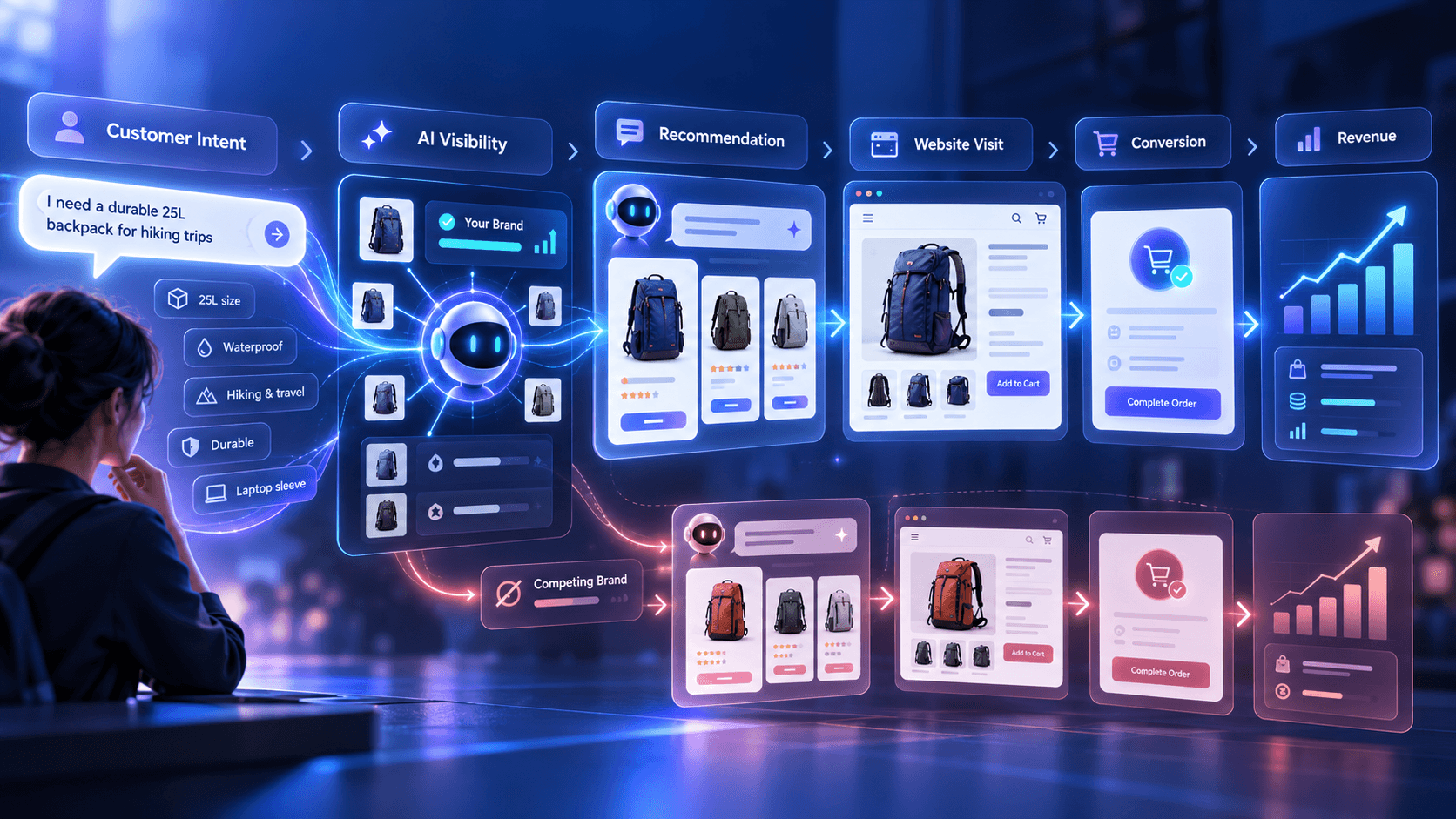
A customer can now ask an AI system for the best product for a very specific need, compare several options, rule out brands that do not meet their requirements and develop a shortlist before visiting a retailer's website. In other words, a meaningful part of the purchase decision may happen before a conventional click is ever recorded.
Google is now making some of that activity easier for sellers to see
In September 2026, Google expanded AI performance insights in Merchant Center for eligible businesses in markets including Australia, Canada, India, New Zealand and the United States. The report gives merchants a view into how brands and products are being discovered across Google's AI shopping experiences, including AI Mode and AI Overviews.
For ecommerce teams, the bigger story is not simply that Merchant Center has another report. The more important change is that AI visibility is becoming a measurable part of ecommerce performance.

Why Clicks No Longer Tell the Whole Story
Traditional ecommerce analytics become most useful after someone takes a measurable action. A shopper sees an ad, clicks a product, lands on a website and moves through the conversion journey.
Conversational shopping can begin much earlier.
Imagine a shopper asking, "What is the best lightweight carry-on backpack for a three-day business trip that fits under an airline seat and can handle rain?"
That question contains a product category, travel use case, size requirement, trip duration and performance expectation. An AI shopping experience can evaluate those details and surface a small group of products that appear to match.
By the time the shopper clicks through to a store, they may already understand which brands look suitable and which ones do not.
That changes what visibility means.
A seller may still have strong organic rankings or healthy paid search performance while barely appearing in AI-generated product recommendations. Another brand may receive fewer traditional search clicks but consistently appear when shoppers ask highly specific purchase questions.
This wider shift from keyword discovery to AI-assisted product selection is explored in XENA's guide to the AI retail search shift in 2026.
The important question is no longer only whether shoppers clicked your product. Sellers also need to understand whether their products were considered in the first place.
What Google Merchant Center Is Now Showing Sellers
Google's AI performance reporting gives merchants a much more useful view of conversational shopping behavior.
The report includes metrics such as share of voice, competitor visibility, query frequency and the number of products appearing for relevant terms, attributes and shopping intents. Google also organizes activity around different stages of the buying journey, including discovery, evaluation and ready-to-buy behavior.
Together, those metrics help answer questions that standard traffic reports cannot answer very well.
A seller can begin to understand whether its products appear when shoppers ask for recommendations, whether competing brands are being surfaced more frequently, which products have the strongest AI visibility and what kinds of customer needs are driving those recommendations.
This is important because a click only tells you that someone arrived. AI visibility data can help explain what happened before they arrived.
AI Share of Voice Is Becoming a Useful Ecommerce KPI
One of the most important metrics in the new report is share of voice.
Google uses this metric to show how frequently a seller's brand or products appear relative to the competitor set associated with the same category and relevant queries.
That gives ecommerce teams something they have not traditionally been able to measure very well: whether the brand is being included in AI-assisted shopping conversations.
Suppose a retailer has solid rankings, good marketplace sales and consistent paid traffic, but its AI share of voice remains low. That may suggest that the brand is performing well once shoppers reach familiar search channels, while competitors are gaining more visibility during conversational discovery.
The opposite can also happen. A smaller brand might not dominate standard search rankings, yet its products may be particularly easy for AI systems to understand because its specifications, attributes and use cases are clearly structured.
This is why AI visibility should be treated as an additional layer of performance rather than a replacement for traffic and conversion metrics.
XENA's guide to how AEO is changing the future of D2C commerce looks at this transition in more detail, particularly the move from ranking for individual searches to becoming part of an AI-generated recommendation.
Competitor Visibility Adds the Context Sellers Need
Your own share of voice is useful, but it becomes far more meaningful when you compare it with the brands competing for the same customers.
A percentage viewed in isolation can easily be misleading. A modest share of voice might still represent strong visibility in a fragmented market, while a seemingly high percentage may hide the fact that a close competitor consistently dominates the most commercially valuable questions.
Merchant Center helps address this by comparing your visibility with the average performance of the competitor group Google associates with your business.
Sellers should avoid treating a single percentage as the final answer, though. The competitor set is defined by Google, and changes to that group can affect the numbers over time.
The more useful approach is to watch trends and ask what is driving them. If competitor visibility rises, look at which products, attributes and buyer-intent queries seem to be contributing to that change.
That can reveal whether another brand is becoming easier for AI systems to understand, whether its product information is more complete or whether it is winning visibility around a use case your own content barely addresses.
XENA's article on how to know if competitors are investing in AEO provides a useful framework for looking at those signals beyond one dashboard.
Product Visibility Shows Which Parts of Your Catalog AI Understands
Brand visibility matters, but ecommerce teams ultimately need to know which products are actually being surfaced.
Merchant Center's product visibility reporting can reveal how many products from a catalog appear for important attributes, search terms and shopping intents.
That distinction matters because a brand can look healthy at the overall level while only a small number of SKUs are generating most of the exposure.
Imagine a retailer with 150 products. If six products account for most AI visibility, the brand technically appears in AI shopping experiences, but the majority of the catalog may still be difficult for those systems to understand.
That could point to incomplete product attributes, unclear descriptions, weak differentiation or missing information about where and how certain products should be used.
The goal should therefore be more specific than simply increasing product mentions. Sellers need the right products to appear for the right reasons.
If an AI system recommends a trail shoe because the product genuinely offers the cushioning, grip or weather protection the shopper requested, that is valuable visibility. If the same product appears because the underlying data is ambiguous or misleading, the recommendation can create a poor customer experience instead.
Clear product information plays an increasingly important role here. XENA's guide on how to write product pages AI actually understands explains how concrete specifications, intended use cases and clearly stated benefits give AI systems better information to work with.

Buyer-Intent Queries May Be More Valuable Than Simple Keywords
One of the most useful parts of Google's AI reporting is the shift toward understanding shopping intent rather than looking only at isolated keywords.
There is a major difference between someone searching for "running shoes" and someone asking for "the best cushioned running shoes for wide feet and daily five-mile runs."
The second query tells you much more about the customer. It reveals the product category, fit requirement, comfort preference and intended use.
For ecommerce sellers, this kind of information can be extremely valuable.
If Merchant Center shows that shoppers frequently ask about arch support but your products have weak visibility around those conversations, there may be an opportunity to improve how relevant product features are communicated.
If shoppers repeatedly mention a particular material, compatibility requirement or use case and that information is missing from your product feed, you may have identified a product-data gap rather than a marketing problem.
The buying stage matters too.
A product might appear frequently during discovery but lose visibility when shoppers begin comparing options. That may suggest the product is easy to discover but lacks the specifications, reviews, comparisons or supporting information needed to remain competitive during evaluation.
This is why buyer-intent data can be more actionable than a conventional keyword report. It helps sellers understand not only what people are searching for, but what they are actually trying to accomplish.
Query Frequency Helps Sellers Decide What to Fix First
Not every visibility gap deserves the same amount of attention.
Merchant Center also provides frequency signals that help merchants understand which terms, attributes and shopping intents appear more often.
That gives teams a practical way to prioritize optimization.
A query with low visibility and very little demand may not need immediate attention. A high-frequency buyer intent where competitors repeatedly appear and your products rarely do deserves a much closer look.
The next step is to investigate why.
Perhaps an important attribute is missing from the product feed. Maybe the title and description do not clearly communicate a relevant benefit. The product page might explain a feature but never connect that feature to the way shoppers actually intend to use the product.
Google has encouraged sellers to use these insights to improve product titles, descriptions and structured product information.
The aim should not be to copy conversational queries into listings or fill descriptions with unnatural phrases. The better approach is to make product information more precise, complete and useful.
When shoppers become more specific, product data needs to become more specific too.
AI Visibility Should Be Connected to a Wider Measurement Framework
Merchant Center gives sellers an important new perspective, but it represents only one part of the AI shopping landscape.
Google's current reporting focuses on organic AI visibility rather than paid advertising performance. Sellers should therefore avoid treating the dashboard as a replacement for the rest of their ecommerce analytics.
A stronger measurement framework connects several signals.
AI share of voice tells you whether the brand is visible. Competitor visibility shows how that position compares with the market. Product coverage reveals which SKUs are being understood. Buyer-intent data highlights the questions customers are asking.
Those signals then need to be connected with familiar commercial metrics such as qualified traffic, conversion rate, revenue and contribution margin.
This is also where XENA SearchPanel can add another layer of context.
XENA SearchPanel helps teams evaluate how individual products appear across multiple AI shopping and answer experiences using realistic buyer questions. Sellers can compare product visibility with competing brands, review the kinds of responses AI systems generate and identify areas where a product may be losing recommendation opportunities.
Merchant Center can help answer how visible your products are within Google's AI shopping ecosystem, while SearchPanel can help ecommerce teams investigate the broader question of how discoverable those products are across AI-driven buying journeys.
Turn Visibility Insights Into Better Product Data
The real value of AI visibility reporting comes from what sellers do with the information.
If Merchant Center reveals strong demand around an attribute that is missing from your feed, add accurate structured data. If customers frequently search around a particular use case, make sure the product page clearly explains whether the item is suited to that situation.
If one SKU consistently performs well while similar products remain invisible, compare how those products are described. Look closely at their titles, attributes, specifications, identifiers and supporting content.
A vague description such as "premium lightweight backpack" gives an AI system very little to evaluate.
A product page that clearly explains dimensions, weight, capacity, laptop compatibility, materials, weather resistance, warranty coverage and intended travel use gives the system far more context.
The difference matters because AI shopping systems increasingly need to determine whether a product fits a specific situation rather than simply matching a broad category.
XENA's 2026 Product Listing Blueprint offers a useful framework for improving product information in ways that support both discoverability and conversion.
Visibility Is Valuable, but Revenue Still Matters
There is one important caution for ecommerce teams adopting AI visibility metrics.
Higher share of voice does not automatically mean higher revenue.
Visibility is best treated as a leading indicator. A product can appear frequently in AI recommendations and still perform poorly if the price is uncompetitive, reviews are weak, stock is unavailable or the product page fails to convert.
The full commercial journey still matters.
AI systems need to understand the product well enough to surface it. The product needs to appear for relevant customer needs. Shoppers then need enough confidence to visit the retailer, evaluate the offer and eventually purchase.
That means AI visibility should be measured alongside business outcomes rather than celebrated in isolation.
XENA's guide to proving AI optimization is driving revenue explores how brands can connect visibility improvements with meaningful commercial results instead of relying on surface-level metrics.
What Ecommerce Teams Should Review Regularly
AI visibility should gradually become part of the normal ecommerce reporting rhythm rather than a separate experiment that gets checked occasionally.
Teams should look at how share of voice is changing, which shopping stages are improving or declining, where competitors are gaining exposure and which products are appearing most often.
They should also pay attention to high-frequency buyer intents where visibility remains weak and compare those findings with recent changes to product data, content, inventory and commercial performance.
Over time, these patterns can become extremely useful.
A team may discover that adding detailed compatibility information improves visibility during product evaluation. Another seller might notice that products with more complete attributes appear for a wider range of conversational searches. A retailer could also find that a competitor repeatedly wins recommendations around a benefit its own product page barely explains.
Those are far more actionable findings than simply knowing that AI traffic increased by a certain percentage.
Ecommerce Measurement Is Expanding Beyond the Click
Google bringing AI performance insights into Merchant Center marks a meaningful change in how ecommerce visibility can be measured.
Clicks, conversions and revenue remain essential, but they increasingly describe only the later stages of the customer journey.
AI shopping introduces another question that sellers now have to answer: Was our product visible while the customer was deciding what to buy?
As conversational shopping becomes a larger part of product discovery, that question will matter more.
The strongest ecommerce teams will continue measuring what happens after someone visits their site, but they will also pay much closer attention to what happens before the click, when AI systems are deciding which products deserve to be part of the conversation.