Ten Tabs, Three Coupon Codes, and One Tired Buyer
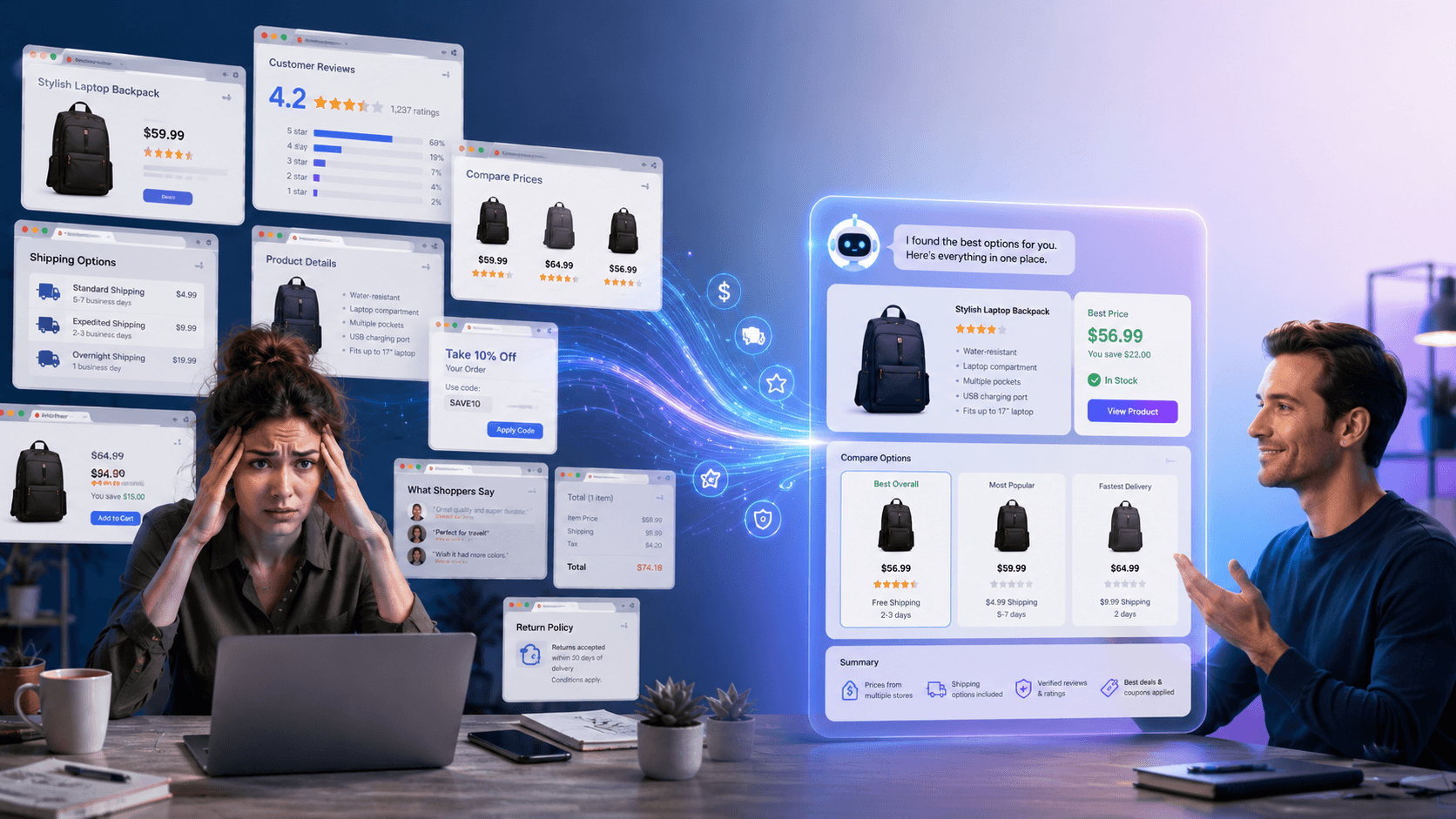
Buying something online should be easy. Then you start looking for the best deal.
One store has the lowest product price. Another includes free shipping. A third offers a member discount, though the item won’t arrive for nine days. Reviews are scattered across several sites, coupon codes keep failing, and the final checkout total looks nothing like the price that first caught your eye.
Soon, you’re staring at ten open tabs and trying to remember which merchant offered the better return policy.
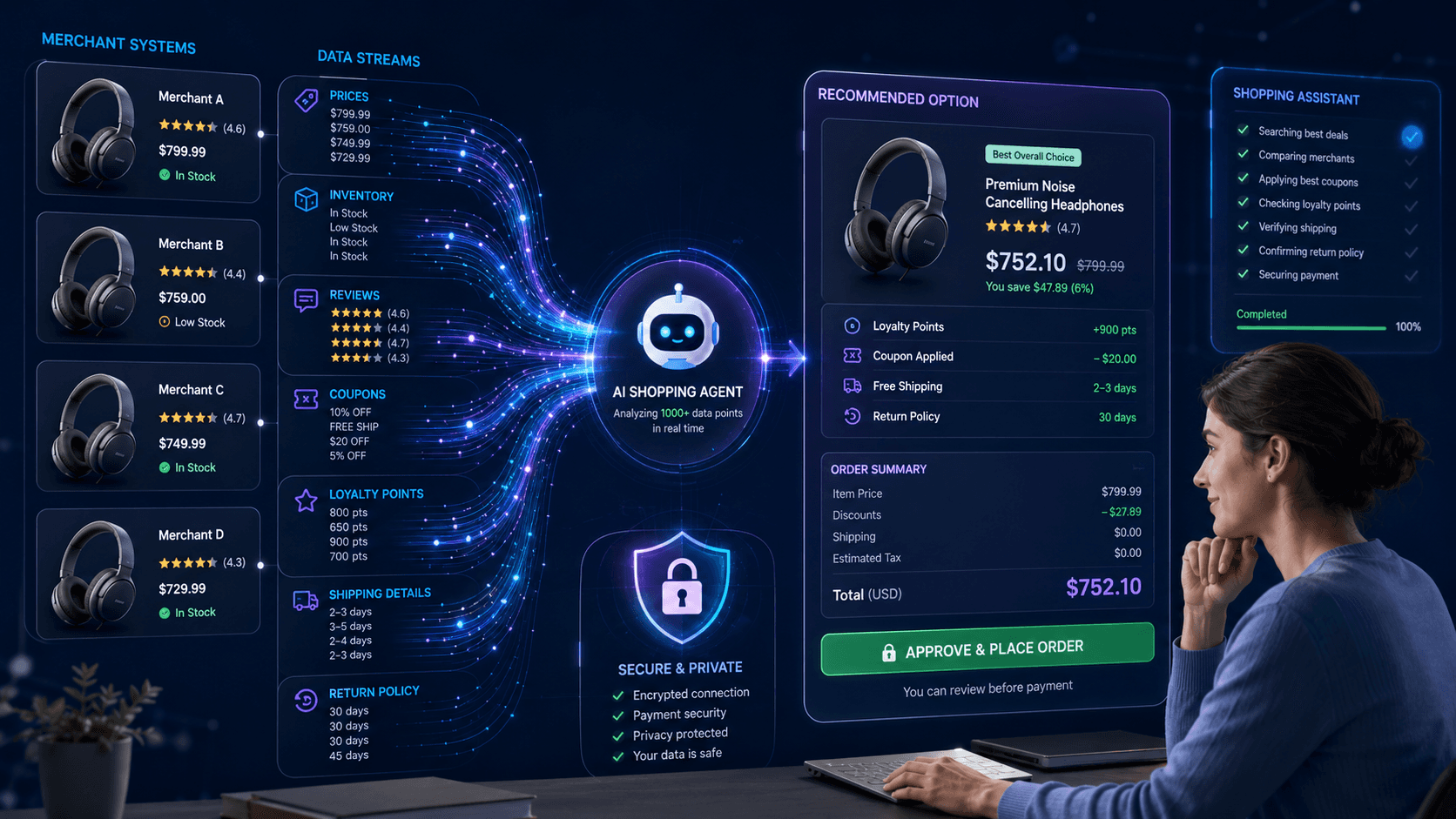
This is the problem agentic commerce is starting to solve. An AI shopping agent can take a goal, search across merchants, compare the real cost of each option, review important product details, check available discounts, and prepare a purchase for approval. Some systems can also track prices or complete eligible purchases after the buyer confirms the details.
The buyer gives the instructions. The machines do the repetitive work.
This move from conversation to action is part of the wider shift covered in XENA Intelligence’s guide to agentic AI in e-commerce and the 2026 AI Commerce Playbook.
What Agentic Commerce Actually Means
A normal shopping search gives you links. A shopping agent works from an assignment.
You might ask it to find a lightweight laptop under $900 with at least 16 GB of memory, strong battery life, a good warranty, and delivery before Friday. The agent can search multiple merchants, remove products that miss your requirements, compare review themes, check shipping charges, and bring back a smaller group of sensible choices.
More advanced tools can monitor a product until its price falls below your limit. Some can recognize eligible loyalty benefits, build a cart, or pass purchase information to a merchant. Checkout usually includes a confirmation step so the buyer can review the price, seller, delivery address, and payment method before money moves.
Current systems still depend on supported merchants, locations, accounts, and payment connections. A feature that works for one retailer may send you to the merchant’s website for another. That’s why a useful shopping agent should clearly explain what it checked, what it couldn’t verify, and which actions still need your approval. Google’s commerce protocol, for example, supports real time catalog details and identity linking so participating platforms can recognize eligible member pricing, free shipping, or loyalty benefits.
The broader change is already shaping how people discover products, as explored in XENA’s guide to the AI retail search shift.

AI Shopping Tools You Can Use Today
Availability can differ by country, plan, account, retailer, and product. These tools represent some of the clearest consumer options available as of July 2026.
ChatGPT Shopping Research
ChatGPT Shopping Research is useful when your request has several conditions. You can describe your budget, intended use, required features, preferred retailers, delivery deadline, and products you want excluded.
The tool asks follow-up questions, researches products across the web, and creates a tailored buying guide. It can compare specifications, prices, reviews, and tradeoffs. It can also help search for deals or eligibility based discounts, such as student offers.
As of July 2026, ChatGPT’s main shopping experience focuses on product discovery and comparison, with purchases completed on merchant websites or apps. Shopping availability is currently centered on the United States and is expected to expand.
For brands trying to appear in these results, XENA’s guide on getting a product catalog seen and recommended in ChatGPT explains why complete product data matters.
Google AI Mode and Universal Cart
Google’s AI Mode can answer natural shopping questions and organize product information such as prices, reviews, images, and inventory. Shoppers can use it to narrow broad searches and compare options without opening a separate page for every merchant.
Google has also introduced agentic checkout features, price tracking, and Universal Cart capabilities. Supported experiences can watch for a target price, bring together products from participating merchants, and use saved payment details after the shopper confirms the purchase. Newer commerce connections can recognize eligible loyalty or member benefits when the shopper links an account. Access remains dependent on the merchant, product, country, and feature rollout.
XENA’s 2026 Ready E-commerce Playbook gives merchants a closer look at how this type of product discovery changes the customer journey.
Amazon Alexa for Shopping, Rufus, and Buy for Me
Amazon’s shopping assistants can research products, answer comparison questions, surface deals, monitor prices, and automate certain repeat shopping tasks for eligible United States customers. Scheduled Actions can handle planned tasks, while price based buying features can act when a product reaches a limit chosen by the shopper.
Shop Direct also shows products from stores across the web. For eligible items, Buy for Me can complete the purchase from an outside merchant using the customer’s confirmed Amazon address and payment information. The merchant still manages delivery, returns, exchanges, and customer service.
This option makes sense for shoppers who already keep their addresses, cards, preferences, and order history inside the Amazon environment.
Perplexity Instant Buy
Perplexity Instant Buy connects product research with checkout for supported merchants. A shopper searches for a product, reviews product cards, selects Instant Buy where available, and confirms the saved checkout details.
The order and payment information go to the merchant, which handles processing and delivery. It’s a practical choice for people who like research with visible sources and want a quicker route from comparison to purchase.
Microsoft Edge Shopping
Microsoft Edge Shopping works as a useful browser layer. When you’re viewing a product, it can compare prices at other retailers, surface available coupons, summarize reviews, and help speed up checkout.
Supported Edge shopping features can also fetch rebates, test or apply coupons, and use autofill information for a faster checkout. It won’t handle every part of a complex shopping assignment, though it can remove much of the last minute coupon hunting.
Give Your Bargain Hunter Better Instructions
A vague request such as “find me the cheapest laptop” can lead to weak choices. The cheapest listing may come from an unfamiliar seller, include an older model, charge high shipping, or carry a limited warranty.
A stronger command tells the agent what “best” means for you.
Find a new 14 inch laptop under $900 for frequent travel and office work. It must have at least 16 GB of memory, eight hours of real world battery life, a backlit keyboard, and a warranty valid in my country. Search at least five reputable merchants. Compare the total delivered price, shipping time, return window, seller reputation, warranty, stock status, and common review complaints. Check public coupon codes, member pricing, card offers, student discounts, cash back, and linked loyalty rewards where permitted. Exclude refurbished products and third party marketplace sellers. Show me the top three choices with the final estimated cost. Don’t purchase anything until I approve the merchant and checkout total.
That prompt gives the agent a budget, purpose, product rules, merchant rules, discount instructions, and a firm spending boundary.
You can also ask the agent to monitor a selected item.
Track this exact model in this color and storage size until August 15. Alert me when the delivered price falls below $780. Don’t substitute another version, and don’t place the order without confirmation.
Clear instructions reduce surprises. They also make the final comparison much easier to trust.
Keep the Agent on a Short Leash
A shopping agent should reduce work without gaining unlimited freedom over your wallet.
Ask it to compare the delivered total, since shipping, taxes, required memberships, and service fees can erase an attractive discount. Tell it to verify the model number, condition, size, color, warranty, and seller before checkout. Return windows deserve the same attention as price, especially for clothing, electronics, furniture, and gifts.
Keep the approval step turned on for anything expensive. Use official integrations rather than sending passwords or full card details through an ordinary message. Purchase alerts and card notifications give you another useful check.
And read the final screen. Prices change, coupons expire, inventory moves, and an agent may work with incomplete merchant data. Shopping Research itself warns that results can contain mistakes in details such as price and availability, so important information should be confirmed at the merchant before buying.
What AI Bargain Hunters Mean for Merchants
Agentic shopping also changes the seller’s job.
An AI assistant needs clear facts before it can recommend a product. Accurate prices, inventory, dimensions, variants, shipping terms, return rules, warranty details, and review signals help the agent understand who the product suits. Structured merchant feeds also make it easier for commerce systems to retrieve current product information.
That means vague product copy will become easier for agents to skip. XENA’s overview of AI applications in e-commerce explains how better product information supports search, personalization, pricing, and customer service.
XENA Foresight helps brands refine titles, product copy, and A Plus content around the questions customers and shopping agents are asking. This connects product visibility with the wider approach described in XENA’s AI playbook for privacy, agents, and continuous optimization.
As shoppers hand more research to assistants, merchants need product pages that a machine can read and a human can trust.
The Best Price Is Becoming a Command
The old routine made the buyer do all the work. Search. Open tabs. Compare shipping. Read reviews. Test codes. Start over when the item sells out.
Agentic commerce compresses those steps into a well written instruction and a final approval.
You may save money. You also reclaim time and attention, which is often the bigger win. Start with a low risk purchase, set a firm budget, require confirmation, and watch how the agent explains its choices.
Then let the machines fight over the price.