
Online shopping is changing fast. A customer can now ask an AI assistant to find breathable sheets under $150, a travel bag that fits a 16-inch laptop, or a moisturizer for sensitive skin.
The assistant may recommend only a few products.
Your store could carry the perfect option and still be left out. That usually happens because the assistant can’t clearly understand the product, confirm its claims, or read the store’s technical data.
AI shopping systems gather clues from product pages, feeds, reviews, forums, articles, and structured data. When those clues are vague or inconsistent, recommending the product becomes risky.
Three problems cause much of that confusion: vague product information, little discussion outside the store, and broken schema markup.
Reason 1: Your Product Data Is Too Vague
Many product pages depend on phrases such as “luxury material,” “premium quality,” and “built for performance.”
They sound positive. They provide almost no useful detail.
An AI assistant can’t easily compare “premium sheets” with other sheets. It can compare sheets made from 100% long-staple Egyptian cotton with a 400 thread count, OEKO-TEX certified dyes, and machine-washable fabric.
Specific facts give the system something solid to work with.
The same rule applies across product categories. A travel backpack needs a capacity, weight, material, laptop size, dimensions, and water-resistance rating. A skincare product needs ingredients, volume, skin type, scent information, and directions. A chair needs measurements, materials, adjustment ranges, and weight limits.
Good product copy can still create desire. But the key facts must be easy to find.
Claims Need Support
“Long-lasting battery” leaves several questions open.
How long does it last? At which setting? Under what conditions? How long does charging take?
A clearer version might say the battery runs for up to nine hours at medium speed and reaches a full charge in three hours through USB-C.
That sentence helps shoppers. It also gives AI systems data they can compare.

XENA Intelligence helps ecommerce teams study listing performance and spot areas where product content lacks clarity. Its AI-powered tools can support faster listing reviews across a large catalog.
You can also read XENA’s guide to product listing optimization.
How to Improve Product Data
Open one of your best-selling product pages and remove every unsupported adjective for a moment. Look at what remains.
Could a person understand the product’s size, material, capacity, compatibility, ingredients, care instructions, warranty, and intended use?
The most useful details depend on the item. Still, every page should answer the questions that shape a buying decision.
For clothing, that may include fabric percentages, fit, garment measurements, stretch, care, and size guidance.
For electronics, it may include battery life, charging type, connection standards, device support, dimensions, and package contents.
For home products, it may include materials, measurements, assembly needs, finish, weight capacity, and cleaning instructions.
Keep these details consistent across the product page, advertising feeds, marketplace listings, and store backend. Conflicting information creates doubt for shoppers and machines.
XENA’s product feed optimization guide explains why accurate, complete, and regularly updated feed information matters across shopping channels.
Write for Real Buying Questions
Customers don’t always search by product name.
They ask questions such as:
“Which carry-on backpack works for a week-long trip?”
“Which pan is safe for an induction cooktop?”
“Which sheets are best for hot sleepers?”
Your page should contain the facts needed to answer those questions. Add useful specifications, short explanations, care details, compatibility information, and common customer questions.
Clear language makes a product easier to recommend.
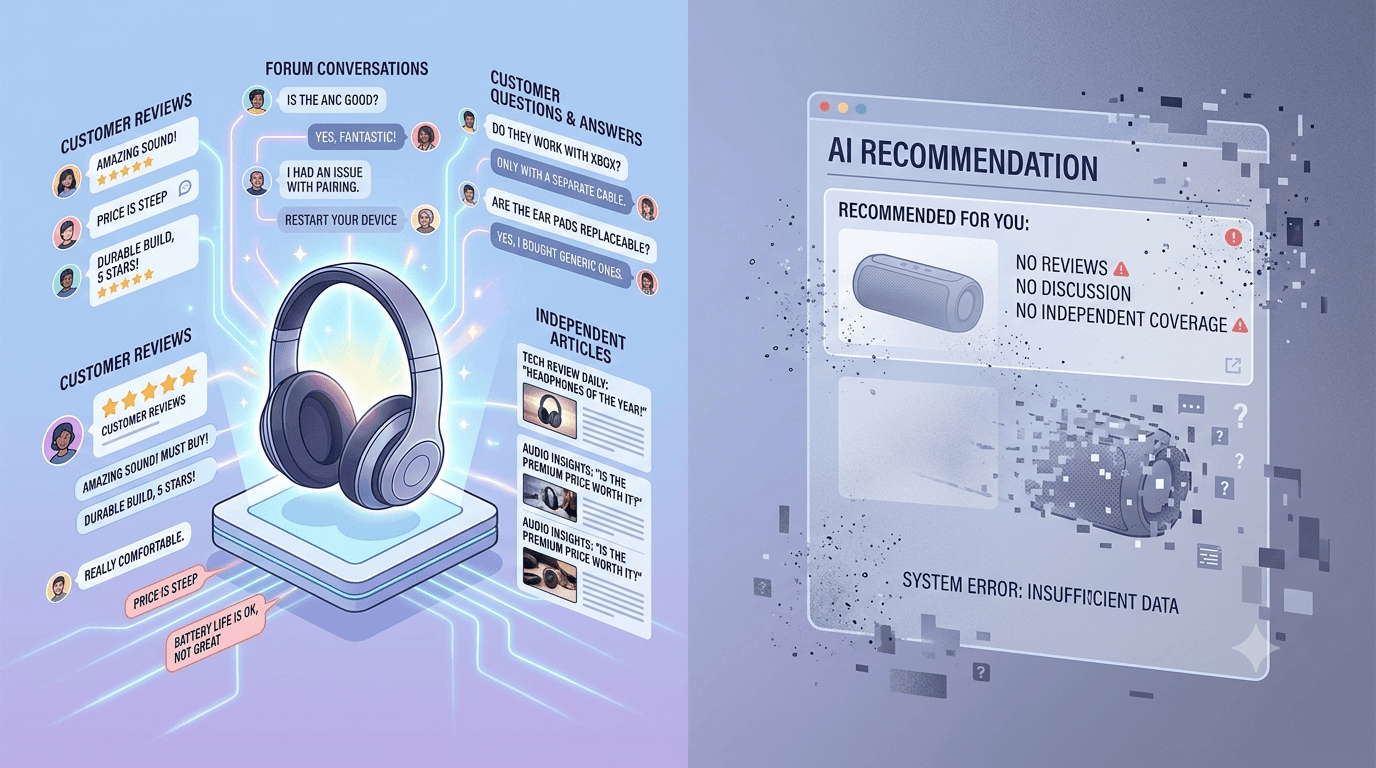
Reason 2: Your Product Has a Community Visibility Gap
Your website will naturally present your product in a positive light. An AI assistant may also look for signs that other people recognize, use, and discuss it.
These signals can appear in customer reviews, forum threads, comparison articles, question-and-answer sites, independent videos, and social conversations.
When a product has little presence outside its own store, AI systems have less context. They may struggle to connect it with a specific customer need.
Picture a company selling an office chair designed for shorter users. The store describes its adjustable seat and foot support. Yet no customer reviews or independent discussions mention how it fits people under 5 feet 4 inches.
That missing context matters.
A detailed customer comment can explain that the user’s feet reach the floor comfortably, the armrests sit at the right height, and the seat depth doesn’t press behind the knees. Those details are much more useful than a broad statement such as “comfortable chair.”
Real Conversations Add Context
A store page describes what the product should do. Customer conversations show how it performs in daily life.
A buyer might explain that a portable fan lasted through a nine-hour outdoor event. A traveler might report that a backpack stayed dry during steady rain. A cook might describe how a pan looked after six months of regular use.
These accounts answer practical questions that polished marketing copy often misses.
Build Discussion Without Faking It
Brands shouldn’t flood forums with disguised advertising. Fake conversations, copied comments, and manufactured reviews can damage trust.
Focus on giving real customers reasons and opportunities to share useful experiences.
Ask verified buyers to describe how they use the product, how long they’ve owned it, what problem it solved, and what surprised them. A detailed review carries more information than “Great product.”
Answer customer questions clearly on your store. Turn repeated support questions into helpful articles. Share honest comparisons that explain which type of buyer will get the most value from the product.
And when your team joins an online community, be open about who you are. Add something useful to the discussion instead of dropping a sales link.
Independent reviews can also help, especially when the reviewer understands the category and tests the product properly.
Read XENA’s 2026 ecommerce playbook for more on how AI-guided shopping is changing the customer journey.
Listen to the Language Customers Use
Community conversations are also a source of customer research.
People may describe your product in ways your marketing team never considered. They may mention a use case, concern, feature, or comparison that deserves a place on the product page.
Use those patterns to improve descriptions, frequently asked questions, support content, and advertising. Keep the wording natural. The goal is to answer real questions with clear information.
Reason 3: Your Schema Markup Is Broken
A page can look perfect on screen and still send confusing information to a crawler.
Schema markup gives search systems a standard way to read details such as product name, image, price, currency, availability, ratings, shipping information, and offers.
Problems start when that data is missing, outdated, duplicated, or different from what appears on the page.
The visible price may be $79 while the structured data still says $89. A product may show as available to the shopper while the schema reports that it’s out of stock. A variant may carry the wrong image, color, size, or product identifier.
Themes, plugins, store apps, custom code, and catalog migrations can all cause these issues.
Google recommends adding Product structured data to product pages and says businesses can also submit product information through Merchant Center feeds. Using both can help Google understand and verify product information.
Check More Than One Product
Test several types of pages.
Review a standard product, an item with variants, a discounted product, an out-of-stock item, and a listing with customer ratings.
The structured data should match the page. Check the product name, brand, description, image, price, currency, availability, identifiers, ratings, shipping details, and return information.
Run another check after changing themes, installing apps, moving catalogs, or editing product templates.
Schema needs regular care.

XENA’s guide to ecommerce listing management covers the value of keeping catalog content accurate and current across channels.
A Simple AI Visibility Check
Choose one important product and ask an AI assistant the questions a real customer might ask.
Use a price range, material, size, feature, compatibility need, or use case. Avoid searching only for your brand name.
Look at which products appear. Pay attention to the details used in the answer.
Then compare those listings with yours.
Are they giving clearer measurements? Do they have more detailed reviews? Are independent sites discussing them? Does their product data stay consistent across the page, feed, and schema?
This exercise can reveal gaps quickly.
Make Your Products Easier to Understand
AI visibility depends on three connected areas.
Your store needs clear product facts. Customers and independent sources need enough information to discuss the product meaningfully. Crawlers need clean technical data that matches what shoppers see.
Start with one high-value product. Replace vague claims with measurable details. Encourage richer customer reviews. Check the schema and product feed for errors.
Then repeat the process across the catalog.
XENA Intelligence helps ecommerce businesses manage listing and performance data through AI-powered analytics, automation, predictive insights, and expert support. That makes it easier to find weak content, improve product information, and respond faster as shopping behavior changes.
Your store may have exactly what the customer needs. Make sure AI assistants can see why.